
Riftbound Unleashed (Summer 2026): Release Date, What We Know, and Where to Pre-Order
Apr 23, 2026·Marcin

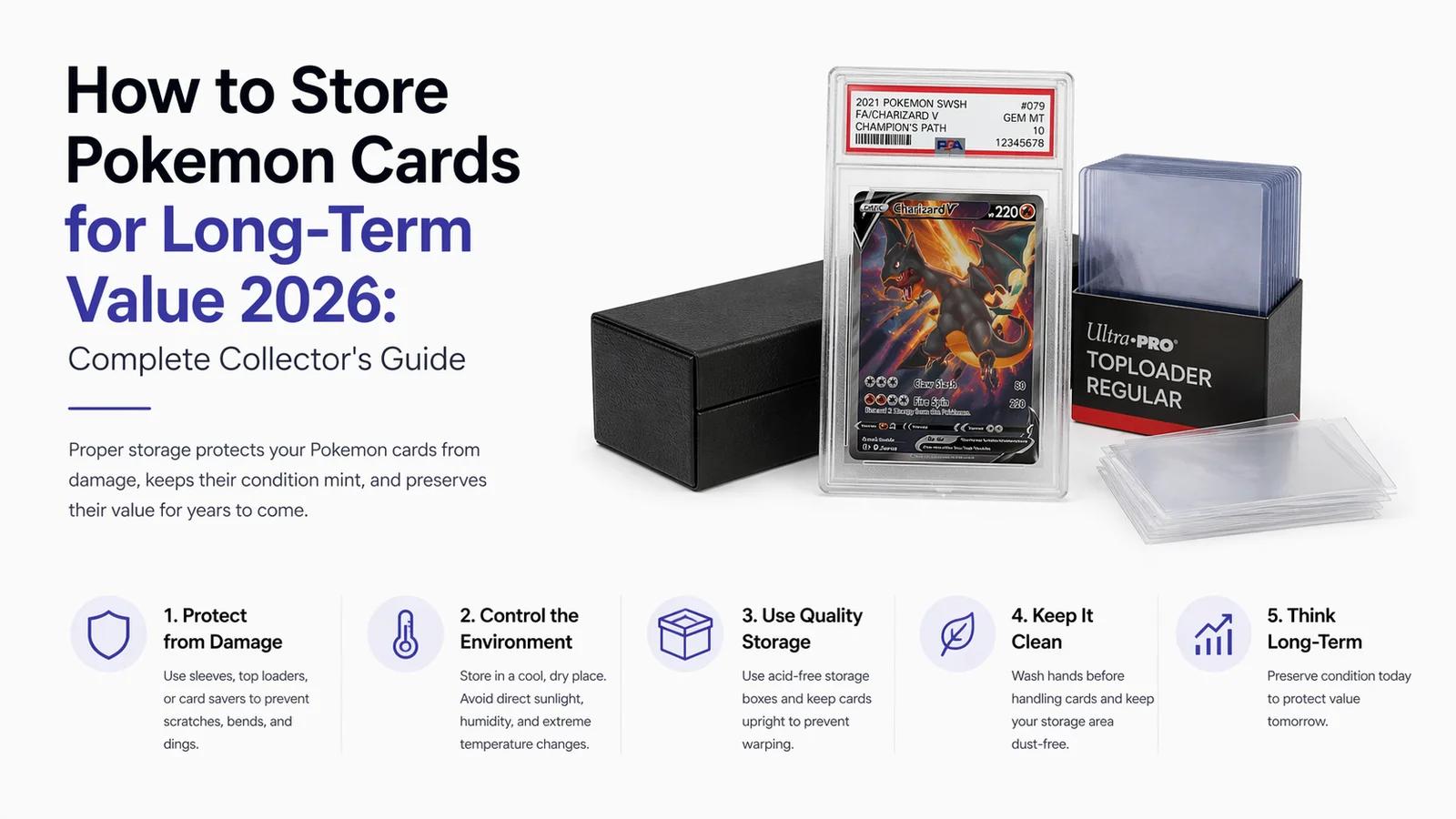
Complete collector's guide to preservation, climate control, and long-term protection
Luffy
Proper storage protects your Pokemon TCG investment from the five main threats: 1) Physical damage (bending, scratching, dropping), 2) Humidity (warping, moldering), 3) Temperature extremes (cards stored in attics or garages suffer), 4) UV light exposure (fading colors, especially foil holos), 5) Poor handling (fingerprints, oils, oxidation). For raw cards, use penny sleeves + top loaders + team bags for individual cards worth £20+, or 9-pocket binders with side-loading sleeves for organized collections. Store at 18-22°C (64-72°F) and 40-50 percent relative humidity. Away from direct sunlight, windows, exterior walls, basements, and garages. For graded cards (PSA, BGS, CGC), store slabs upright in cardboard dividers or dedicated slab boxes. For high-value collections (£5,000+), consider dedicated climate-controlled storage like a humidor (2% humidity-controlled) or climate-controlled closet. Insurance via homeowner's policy often covers up to £1,500; dedicated collector insurance starts at £100/year for £25,000 coverage. This guide covers every aspect of long-term Pokemon card preservation in 2026.
Pokemon cards are susceptible to environmental damage that can reduce value by 30-90 percent. Understanding the threats helps you prioritise protection.
The most common cause of value loss. Sources:
Bending: Even slight bends (seen as "whitening" on card edges) drop PSA grade from 10 to 7-8.
Scratches: on holo or foil surfaces, reducing visual appeal.
Corner damage: rounded corners from handling, dropping, or poor sleeves.
Surface marks: from fingerprints, oils, or contact with other objects.
Prevention:
Handle cards with clean, dry hands (ideally cotton gloves for high-value cards).
Always use penny sleeves for any card you pick up.
Never stack cards without dividers.
Transport in rigid containers (not loose in bags).
Humidity is the silent killer of card collections. High humidity (above 60 percent) causes:
Warping: cards bend and twist.
Mouldering: visible mould growth on cardboard.
Adhesion: cards stick together.
Ink bleeding: printed colors fade or run.
Low humidity (below 30 percent) causes:
Brittleness: cards become fragile and crack.
Shrinkage: paper shrinks and tears.
Optimal range: 40-50 percent relative humidity.
Cold (below 10°C): paper becomes brittle, prone to cracking when handled.
Hot (above 30°C): accelerated degradation, binder glue failure, ink fading.
Temperature swings (day-night cycles in uninsulated spaces): expansion/contraction stresses paper.
Optimal range: 18-22°C (64-72°F).
UV radiation is particularly damaging to Pokemon cards:
Color fading: especially problematic for holo foils, rainbow rares, and gold cards.
Paper yellowing: over years of exposure, card base colors shift.
Ink degradation: fading of dark colors (especially reds and purples).
Prevention: Store cards away from windows, avoid open display under sunlight, use UV-filtering glass if displaying.
Every touch leaves residue:
Skin oils: absorbed into paper, accelerate degradation.
Moisture from breath: in warm rooms.
Dust accumulation: scratches during cleaning attempts.
Prevention: Cotton gloves for vintage cards, clean hands (wash + dry before handling), avoid touching surfaces directly.
Let's go through the complete toolkit for Pokemon card storage, from entry-level to professional-grade.
The first layer of protection for any card.
Recommended brands:
Ultra PRO Penny Sleeves: industry standard, 1-penny protection, clear PVC.
Dragon Shield Penny Sleeves: premium option with anti-static.
KMC Perfect Fit: Japanese brand, ultra-thin for inner sleeving.
Cost: £0.02-0.10 per sleeve (bulk). £5-15 for 100 sleeves.
Usage: Every card worth £5+ goes in a penny sleeve. For high-value vintage (£200+), double-sleeve with a KMC Perfect Fit under a Dragon Shield.
For single-card rigid protection.
Recommended brands:
Ultra PRO Top Loaders: standard 3x4 inch, 35pt thickness.
BCW Top Loaders: slightly cheaper alternative.
Premium Graded Card Top Loaders: specifically for slabbed cards (larger to fit PSA/BGS slabs).
Types:
Standard 35pt: for single raw cards.
55pt, 75pt, 100pt, 130pt: for thicker cards or relic cards.
Jumbo: for large promo cards.
Cost: £0.10-0.30 per top loader.
Usage: After penny sleeving, top loader provides rigid protection. Essential for cards worth £20+.
Small plastic bags that seal around top loaders.
Brands:
Ultra PRO Team Bags: standard.
BCW Team Bags: equivalent.
Cost: £0.01-0.05 per bag.
Usage: Encloses top loader so cards don't slide out during storage or transport. Essential for shipping to grading services.
For organized collections you want to view and access.
Types:
Side-loading binders (safer):
Cards slide in from the side.
Pockets stay securely closed.
Recommended: Ultra PRO Pro Binder Side Loading, Dragon Shield Matte Binder.
Top-loading binders (standard):
Cards slide in from the top.
Potential for cards to fall out if handled roughly.
9-pocket vs 12-pocket vs 20-pocket:
9-pocket (3x3 grid): most common, good for standard collections.
12-pocket (4x3 grid): smaller pockets, more cards per page.
20-pocket: for smaller accessory cards.
Brands ranked by quality:
Dragon Shield Matte Binder - premium, no PVC, no acid.
Ultra PRO Pro Binder - solid, archival-quality.
Vault X Exo-Tec Binder - premium with anti-theft features.
BCW Pro 9-Pocket Binder - budget option.
Cost: £15-50 for binders, £5-15 per pocket page.
Important: Use only PVC-free, acid-free sleeves in binders. PVC sleeves degrade over time and damage cards.
For bulk collections, unsleeved or sleeved but non-individually protected.
Types:
BCW Trading Card Storage Box: standard 800-count, 1,000-count, 3,200-count boxes.
Ultra PRO Storage Box: similar sizes.
Archival quality boxes: acid-free, alkaline-buffered cardboard.
Sizes:
800-count: for 600-800 cards in penny sleeves.
1,000-count: larger standard.
3,200-count: for large collections.
Bank boxes: for thousands of cards, organised by set.
Cost: £2-10 per box.
For PSA, BGS, or CGC slabbed cards.
Types:
Ultra PRO Slab Box: holds 25-50 slabs upright.
Dragon Shield Slab Box: premium alternative.
Custom wooden cabinets: for collectors with hundreds of slabs.
Cost: £15-40 per box.
For showcasing top cards.
Types:
Wall-mounted display: wall-mounted cases for display.
Tabletop shadow boxes: decorative frames.
UV-filtering glass: essential for display pieces to prevent fading.
Cost: £20-200+ depending on size and quality.
Important: Display pieces should use UV-filtering glass. Cards on open walls should be considered "display items" not "archival" items - their value degrades faster.
For serious collectors (£5,000+ collection value), climate control is essential.
Target: 18-22°C (64-72°F).
Solutions ranked by cost:
Interior closet (free): an interior room/closet without exterior walls or windows usually maintains 18-24°C.
HVAC system: regular heating/cooling keeps rooms consistent.
Dedicated climate-controlled storage (£500-3,000): wine fridges or humidor cabinets repurposed for cards.
Dedicated closet with mini-split AC (£3,000+): professional collector storage.
Avoid:
Attics: temperatures swing from freezing to 40°C+ seasonally.
Basements: high humidity.
Garages: temperature swings and humidity.
Exterior walls: temperature swings.
Near heating vents or radiators: high temperatures.
Near refrigerators (bad humidity control).
Target: 40-50 percent relative humidity.
Solutions:
Silica gel packs: passive humidity control in boxes. Cost: £0.50-2 per pack. Replace yearly.
Dehumidifier (£50-300): active humidity reduction for room.
Humidifier (£40-200): if environment is too dry.
Hygrometer (£15-50): monitor humidity levels.
Specific equipment:
Boveda 2-Way Humidity Control: pre-calibrated humidity packs, typically 49% or 62% RH. Ideal for collector humidors. Cost: £3-8 per pack.
Bulk silica gel: cheaper for large collections but less precise.
Humidor cabinets: originally for cigars, repurposed for cards at 50% RH.
For UK collectors specifically:
Humidity varies by region in the UK:
South/Southeast England: moderate, 55-70 percent humidity typical.
West/Scotland/Wales: high humidity, often 70-85 percent.
East/North England: moderate.
Use a hygrometer to measure your storage area's actual humidity.
Solutions:
Store in interior rooms without windows.
Cabinets with opaque doors (not glass).
UV-filtering glass for display pieces: blocks 99% of UV. Cost: £20-200+ depending on size.
Curtains/blackout blinds over any storage areas with windows.
Setup:
Penny sleeves for cards worth £5+.
Top loaders for cards worth £20+.
Standard 9-pocket binder for organized display.
Interior room shelf or drawer storage.
Humidity within natural UK range (50-70 percent with no active control).
Total storage cost: £30-100.
Setup:
Dragon Shield Matte Binder with 9-pocket pages.
Top loaders + team bags for all cards worth £20+.
800-count storage boxes for bulk cards.
Slab box for any graded cards.
Closet storage in insulated interior room.
Silica gel packs in all boxes.
Total storage cost: £150-500.
Setup:
Multiple Dragon Shield Premium Binders.
Ultra PRO or premium top loaders for every card.
Slab boxes for all graded cards.
Climate-controlled closet.
Humidity monitoring (hygrometer + Boveda packs at 49% RH).
Acid-free archival boxes for bulk storage.
Total storage cost: £500-1,500.
Setup:
Dedicated wine fridge or humidor cabinet for environmental control.
Custom slab cabinets.
UV-filtering display for showcase pieces.
Safe or safe deposit box for ultra-high-value (£10,000+ cards).
Professional-grade insurance.
Total storage cost: £2,000-10,000+.
The most valuable category. Extra care required:
Double-sleeve: penny sleeve inside KMC Perfect Fit.
Top loader: 35pt or 55pt rigid protection.
Team bag: sealed.
Storage box: acid-free.
Never bend or touch directly: always handle via sleeve/top loader.
Avoid temperature changes: consistent 18-22°C.
Investment: £1-3 per card in storage materials; worth it for £100+ card value.
Single penny sleeve: adequate for most cards.
Top loader for cards worth £10+.
Binder storage fine for cards worth under £50.
Team bag for mailers and shipping.
Slabs are the card's armor. Storage considerations:
Never attempt to open slabs: breaks authenticity certification.
Upright storage in slab box: minimises potential slab damage.
Cardboard dividers between slabs: prevents scratching.
No direct sunlight: UV can damage slab label and card inside.
Climate control important: humidity over 60% can affect slab over decades.
Same principles as English cards.
Japanese cards tend to be slightly thicker (typical centering differences).
Rarer Japanese cards often require PSA/Beckett grading for value preservation.
Sealed products have their own storage considerations:
Original packaging: never open if intending to preserve value.
Upright storage to prevent warping.
Dust cover or polypropylene sheet: protects labels from dust.
Temperature critical: 18-22°C stable.
Humidity critical: 40-50 percent.
Acid-free storage: ensure surrounding storage is acid-free.
For sealed products worth £500+, climate-controlled storage is essential. Sealed Pokemon 151 booster boxes have shown 100-500 percent appreciation over 12-24 months for pristine-condition sealed - worth the storage investment.
At certain value thresholds, insurance becomes essential.
Most UK home insurance covers personal belongings up to a limit (typically £1,500-5,000 per item). For collections under £5,000 this may be adequate, but:
Check if your policy covers "collectibles" specifically.
Verify the per-item limit.
Document collection with photos, values, receipts, and serial numbers (for graded cards).
Keep receipts and authentication documents.
For collections over £5,000, specialist insurers offer better coverage:
Collectibles Insurance Services: US-based with UK/EU support.
British Collectibles Insurance: UK specialist.
Hiscox: high-end collectors' insurance.
Typical rates: 0.5-1% of collection value annually.
Example: £25,000 collection = £125-250 annual premium for £25,000 coverage.
Coverage typically includes:
Fire.
Theft.
Flooding.
Transit (shipping to/from grading).
Mysterious disappearance.
Documentation required:
Photographic record of all items.
Appraisal for premium items (usually requires professional valuer for cards over £2,000).
Serial numbers for graded cards.
For ultra-high-value cards (£10,000+ individual), consider bank safe deposit box:
UK banks typically charge £50-250 annually.
Climate-controlled typically, though humidity may vary.
Not insured by bank (need separate insurance).
Limited access hours.
If you plan to grade cards in the future, storage decisions matter:
Maintain cards in perfect condition: sleeves + top loaders.
Avoid handling: if possible, don't open sleeves.
Document provenance: receipts, where purchased.
Keep original packaging: especially for sealed products.
When shipping to PSA, Beckett, CGC, or TAG:
Penny sleeve: every card.
Top loader: rigid protection.
Team bag: prevents falling out.
Padded mailer or cardboard box with bubble wrap.
Royal Mail Signed For Special Delivery (UK domestic) or UPS/DHL/FedEx (international).
Full insurance: to declared value.
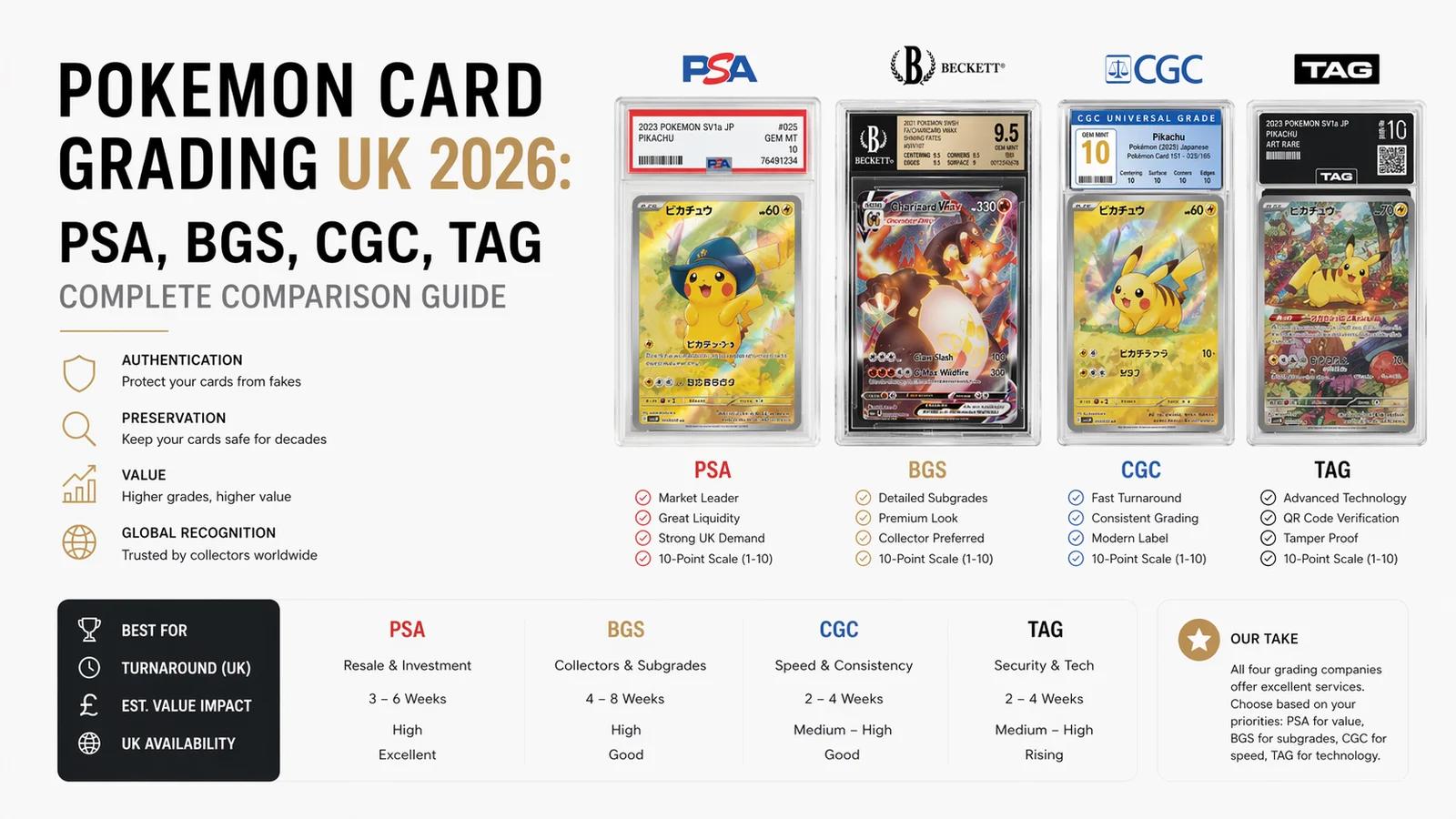
Beckett (BGS) offers 1.75 percent Soleback cashback via Soleback Beckett Partner. Activate before submitting. Learn more in our Pokemon Card Grading UK guide.
When sending cards through mail for purposes other than grading (selling, trading):
Royal Mail Signed For Special Delivery Next Day: tracked, insured up to £2,500. Cost: £6-15 depending on weight and insurance.
Royal Mail Tracked 48: less expensive alternative for low-value cards.
Use rigid cardboard mailers (e.g. Ultra PRO mailer) for cards.
DHL Express: 2-5 days internationally, £25-80 for small parcels.
UPS Express Saver: similar to DHL.
FedEx International Priority: 2-5 days.
Customs declaration: always declare as "collectible trading cards" with accurate value. Undervaluing risks customs seizure.
Individual sleeves + top loaders + team bags.
Cardboard stiffener in envelope.
Hard plastic envelope (Ultra PRO Ship Card) for high-value cards.
Padded outer mailer.
Signature required.
Insurance up to full declared value.
Maintain a collection inventory:
Spreadsheet with: card name, set, year, condition, purchase price, current value.
Photos of each valuable card (both sides).
Receipts saved.
Graded card certificates archived.
This documentation helps with:
Insurance claims.
Estate planning.
Selling decisions.
Condition tracking over time.
When handling raw cards:
Clean, dry hands (wash and dry thoroughly).
Cotton gloves for vintage cards (£200+ value).
Handle by edges only, not surfaces.
Work on clean flat surface away from food, drinks.
Avoid touching directly; use sleeve pulling technique.
Every 6 months:
Check for mold or damage signs.
Verify humidity in storage area.
Rotate cards if in binders (to avoid prolonged pressure).
Check slab integrity on graded cards.
Some cards benefit from re-grading after years of storage:
Raw cards in mint condition: grading adds value.
Cards where original grade was uncertain: re-grading may upgrade.
BGS 10 Gem Mint that might qualify for Pristine Black Label: worth re-evaluating.
Crossgrading (BGS to PSA for example) can add value for some cards but adds cost and risk of downgrade.
When selling graded or raw cards from long-term storage:
Before selling:
Verify PSA/Beckett/CGC slab is intact.
Ensure no degradation has occurred.
Photo document current condition.
StockX for authenticated cards with 1 percent Soleback cashback on buyer side.
Cardmarket: largest European TCG marketplace.
eBay UK/DE: established buyer base.
PWCC Marketplace: US-based, specialty for high-end.
Heritage Auctions or Goldin for ultra-high-value (£5,000+).
A well-stored collection typically appreciates:
Vintage WOTC: 10-50 percent annual appreciation (over 5-10 year periods).
Pokemon 151: seen 200-400 percent appreciation in 2 years.
Moonbreon: 100x appreciation from 2021 to 2026.
Proper storage preserves this appreciation. Poor storage can wipe out entire gains.
1. Using PVC sleeves in binders. PVC breaks down over years, staining cards. Always use acid-free PVC-free sleeves.
2. Storing in basement or attic. Temperature swings and humidity ruin cards over years.
3. Direct sunlight display. Even "light" sunlight fades foils within 6-12 months.
4. Loose cards in boxes. Cards shift and damage each other without sleeves.
5. No humidity control. UK's naturally 60-80 percent humidity is damaging long-term.
6. Ignoring insurance. Collection worth £10,000+ without insurance = disaster waiting.
7. Not documenting. No inventory or photos = difficulty with insurance claims or estate planning.
8. Handling cards without washing hands. Oils and residue degrade over months.
9. Storing graded slabs horizontally. Cracks over time; vertical storage is better.
10. Not rotating binder cards. Prolonged pressure in binder pages damages cards.
What's the best storage for valuable Pokemon cards? Climate-controlled interior room with 18-22°C temperature and 40-50 percent humidity. Graded cards in slab boxes, raw cards in penny sleeves + top loaders + team bags. Regular 6-month inspection.
How should I store Pokemon 151 booster boxes? In original shrink wrap, upright (not lying flat), in climate-controlled interior storage. Away from sunlight and humidity.
What humidity level is safe for Pokemon cards?40-50 percent relative humidity is ideal. Anything over 60% risks warping and mold. Anything under 30% risks brittleness.
Can I store Pokemon cards in a safe? Yes, safes provide security but often lack humidity control. Add silica gel packs or Boveda humidity control packs if storing collectibles in a safe.
How long does it take Pokemon cards to fade in sunlight? Holo foils can show visible fading within 3-6 months of daily sunlight exposure. Regular cardboard cards may take years to visibly yellow.
Are Ultra PRO sleeves good enough? Yes for most purposes. Ultra PRO is industry standard. Dragon Shield is premium alternative with slightly better archival properties.
Should I grade every valuable Pokemon card? No. Grading costs £20-50 per card, so only worthwhile for cards where PSA 10/9 expected value exceeds raw value by 2-3x or more. Cards under £100 raw rarely benefit from grading.
How often should I check my stored cards? Every 6 months minimum. Monthly for cards in less-ideal storage conditions.
Can temperature extremes cause immediate damage? Sudden temperature changes (e.g., hot car in summer) can cause cards to warp quickly. Gradual fluctuations are less damaging but cumulative.
Does vacuum sealing help for Pokemon cards? Generally no. Vacuum sealing can cause pressure damage to cards and restricts airflow, creating micro-climate issues. Stick with sealed boxes and climate control.
What's the best binder for Pokemon cards? Dragon Shield Matte Binder with side-loading 9-pocket pages is considered premium by collectors. Ultra PRO Pro Binder is solid alternative.
Can I store cards in my attic? No. Attics experience extreme temperature swings (freezing in winter, 40°C+ in summer) that damage paper over years.
Should I sleeve every card? Every card worth £5+ should be in a penny sleeve. Bulk cards (under £1 value) can be loose in 3,200-count boxes for space efficiency.
How do I prevent theft of my collection?
Don't publicly share collection details on social media. 2) Safe with combination lock. 3) Safe deposit box for ultra-high-value. 4) Insurance covers theft. 5) Home security system.
What insurance do I need for £10,000 Pokemon collection? Specialist collector insurance like Collectibles Insurance Services or Hiscox. Typical premium 0.5-1% of collection value annually (£50-100 for £10,000 coverage).
How do climate changes affect long-term storage? Stable environments preserve cards best. Regional UK humidity ranges (55-85 percent) require active humidity control for long-term preservation.
Should I store cards in a bank safe deposit box? For ultra-high-value cards (£10,000+ individual), yes. Provides security but may have variable humidity. Maintain your own climate control during any extended home storage transit.
Can Pokemon cards be stored with other paper (like comics)? Yes, but comics and cards have different storage requirements in some cases. Cards are more moisture-sensitive; comics often benefit from slightly higher humidity (50%). If storing together, aim for 45% RH as compromise.
Raw cards under £20:
Penny sleeve + top loader (optional).
800-count storage box.
Interior room storage.
Raw cards £20-100:
Penny sleeve + top loader + team bag.
Acid-free storage box.
Climate-controlled shelf/drawer.
Raw cards £100-500:
Double sleeve (Dragon Shield + KMC Perfect Fit).
Premium top loader + team bag.
Acid-free storage box with silica gel.
Climate-controlled closet.
Raw cards over £500:
Premium double-sleeve.
Reinforced top loader.
Climate-controlled storage.
Consider grading (PSA/BGS/CGC).
Insurance.
Graded cards:
Slab boxes with dividers.
Upright storage.
Climate-controlled.
No direct sunlight.
Photo inventory.
Sealed booster boxes:
Original packaging preserved.
Upright storage.
Temperature 18-22°C, humidity 40-50 percent.
Dust protection.
Acid-free storage area.
For all storage:
Interior room (no exterior walls/windows).
Temperature 18-22°C (64-72°F).
Humidity 40-50 percent.
Silica gel or Boveda humidity packs.
Regular 6-month inspection.
Documentation for insurance.
Following these practices ensures your Pokemon TCG investment preserves value for decades. For serious collectors, storage is not a cost - it's an investment in your investment.

Save on your next purchase
Browse our partner stores for cashback deals and voucher codes
Luffy
Author