
Booking.com: payment, cancellation, Genius and check-in. The complete guide
Sep 28, 2026·Soleback Team

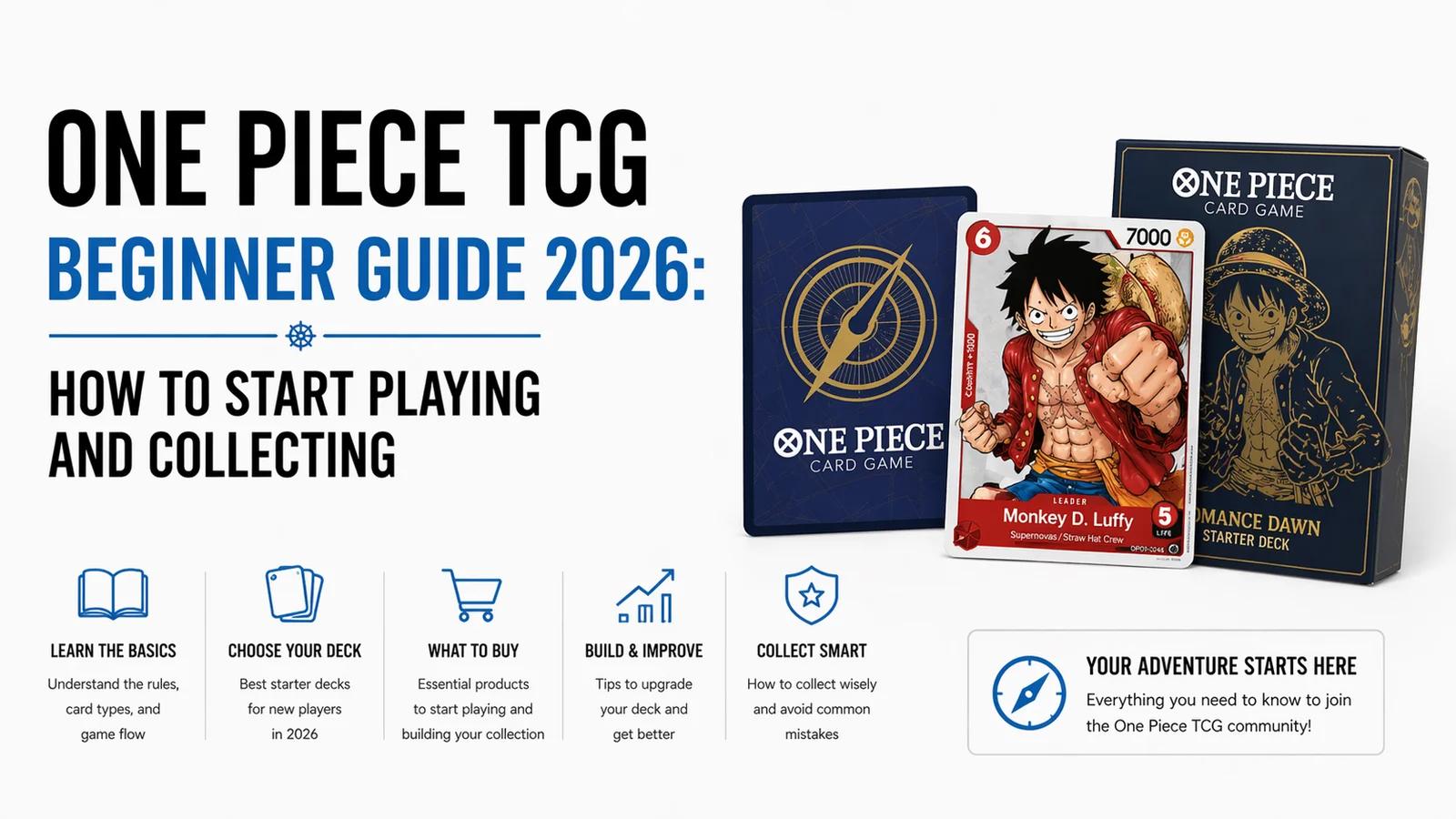
Complete beginner guide to One Piece TCG in 2026. Rules, decks, budget options, and how to start playing or collecting the fastest-growing TCG.
Luffy TCG
One Piece TCG (produced by Bandai) launched internationally in late 2022 and has grown into the third-largest TCG globally by 2026, behind Magic: The Gathering and Pokemon. The game uses a unique Leader-Life-DON!! system that distinguishes it mechanically from Pokemon and Magic. Starter decks (ST series) cost $15-25 and provide ready-to-play decks with minimal additions needed. Boosters (OP series) are where competitive singles and collection value live. This guide walks through rules, deck selection, budget progression, and collection strategy for complete beginners.
One Piece TCG is a two-player card game based on Eiichiro Oda's manga/anime franchise One Piece. Players build decks of 50 cards plus a Leader card and DON!! deck (10 cards), then battle by deploying Characters, using Events, and attacking the opponent's Life cards until one Leader reaches 0 Life.
Game mechanics summary:
Each player chooses one Leader (like a commander) that defines deck color identity and provides special abilities
Leaders have 4-5 Life cards at game start (these get discarded when attacked)
DON!! cards are energy tokens that boost power and activate abilities
Characters are played from hand using DON!! as cost
Combat uses Power values; attacker Power must exceed defender Power (or equal, depending on interpretation)
When your Leader takes attacks, you lose Life cards (which go to hand as insurance)
Win condition: reduce opponent's Leader to 0 Life
Game length: 10-20 minutes per game typical, 25-35 minutes for complex matchups.
Complexity: Moderate. Easier to learn than Magic, more tactical than Pokemon.
One Piece TCG has 6 colors, each with identity themes:
Red: Aggressive, low-cost Characters, direct combat. Straw Hat Pirates, Big Mom Pirates flagship leaders.
Green: Tempo and Rest/Ready manipulation. Alabasta and East Blue arcs. Vivi, Smoker leaders.
Blue: Control, bounce effects (returning cards to hand), resource denial. CP9, Baroque Works. Crocodile, Magellan leaders.
Purple: DON!! manipulation, ramp, big Characters. Marine Admirals, Warlords. Aokiji, Kaido, Blackbeard leaders.
Black: Cost reduction, sacrifice, graveyard interaction. Thriller Bark, Impel Down. Boa Hancock, Kuzan leaders.
Yellow: Life manipulation, Skypiea-themed recently (OP-15), lightning and sky imagery. Enel leaders dominant.
Two-color (bicolor) Leaders exist combining two colors, expanding deck-building options.
Starter Decks are 50+1 card ready-to-play products designed for new players. Each features a specific Leader and theme.
Recommended beginner starters:
ST-01: Straw Hat Crew (Red): Luffy leader. Aggressive, easy to understand. Best introduction.
ST-02: Worst Generation (Purple): Kid leader. Teaches DON!! manipulation.
ST-03: The Seven Warlords (Green): Crocodile leader. Teaches tempo.
ST-09: Side Yamato (Yellow): Yamato leader. Introduces yellow color.
ST-13: The Three Brothers (Red): Ace-Sabo-Luffy leader. Modern starter with strong utility.
Cost: $15-25 per starter deck at retail, $20-40 from resellers.
Playability: ST decks are tournament-legal but typically outclassed by top-tier OP deck lists. Good for learning, FNM (Friday Night Magic-equivalent casual) play, and demonstrating the game to friends.
OP sets are the main expansion products. Each set contains ~120 cards across multiple rarities. Pack size is 6 cards.
Current OP sets available:
OP-01: Romance Dawn (July 2022, reprinted multiple times)
OP-02: Paramount War (October 2022)
OP-03: Pillars of Strength (February 2023)
OP-04: Kingdoms of Intrigue (June 2023)
OP-05: Awakening of the New Era (October 2023)
OP-06: Wings of the Captain (February 2024)
OP-07: 500 Years in the Future (June 2024)
OP-08: Two Legends (October 2024)
OP-09: Emperors in the New World (February 2025)
OP-10: Royal Bloodlines (May 2025)
OP-11: A Fist of Divine Speed (August 2025)
OP-12: Legacy of the Master (November 2025)
OP-13: Carrying on His Will (February 2026)
OP-14: The Azure Sea's Seven (May 2026 - upcoming)
OP-15: Adventure on Kami's Island (May 2026 - upcoming)
OP-16: The Time of Battle (April 2026 - current release)
OP-17: The World's Strongest Warriors (August 2026 - upcoming)
Booster pack cost: $3-8 per pack MSRP depending on set and region. Booster box (24 packs): $75-180 MSRP, $100-250 at market.
Double Pack Sets: Two-pack products with exclusive parallel art cards. $15-25 each.
Premium Booster Sets (Extra Boosters / EB series): Special premium releases with higher pull rates. $5-10 per pack.
Starter Deck Side Sets (ST-10+): Higher-quality starters with more playable cards. $20-35.
Gift Collections: Holiday-themed premium boxes with exclusive promos. $40-80.
Step 1: Buy 2 starter decks of different colors. Budget: $30-50. This gives you two complete decks and lets you teach a friend simultaneously.
Step 2: Watch a tutorial video. The Bandai official channel has rules explanations, and community creators like OPTCG Insider, Emerging Empire, and Let's Play One Piece have beginner-friendly content.
Step 3: Play 5-10 games with the unmodified starters. This builds baseline understanding of turn structure, combat, and card interactions.
Step 4: Identify which color/leader resonates with you. If you love the aggressive playstyle of Red, you'll lean toward Red expansions. If you prefer control, try Blue next.
Step 5: Buy singles or boosters to upgrade one starter toward a more competitive build. Budget: $50-150 for a playable upgrade.
Step 6: Find local play. Many local game stores run weekly One Piece TCG events (check with local stores). Online play exists via Tabletop Simulator mods, One Piece TCG Sim (community tool), and Card Game Arena.
Budget tier ($50 total): Upgraded starter with key singles added. Competitive at casual level.
Entry competitive ($100-200 total): Focused deck with 2-3 chase commons/uncommons and one key rare. Capable of winning local casual events.
Competitive ($250-500 total): Tournament-playable with most chase uncommons and a few rares. Consistent top-8 at local events.
Meta competitive ($500-1000 total): Complete build of a current top-tier deck. Capable of winning regional events.
Premium competitive ($1000-3000 total): Includes signed, alt-art, or foiled versions of playable cards. Performance equivalent to meta competitive; spend differential is for collection/display.
One Piece TCG uses this rarity hierarchy (bottom to top):
C (Common): Base cards, mostly chaff
UC (Uncommon): Commonly useful cards
R (Rare): Playable cards, often deck staples
SR (Super Rare): Strong cards, often include key Characters and Events
L (Leader): Leader cards (always rarity L regardless of power)
SEC (Secret Rare): Top-tier Characters with special art, often the set's chase
SP Card (Special): Foiled or special-treatment variants
Parallel (P): Alternate art versions, multiple tiers
Alternate Arts (AA or Alt Art): Parallel versions of cards with full-art illustrations. These are typically the most sought-after collector cards. SEC Alt Arts are the single most valuable cards in most sets.
Meta shifts with each new set. Currently relevant leaders:
Aokiji (OP-16, Blue): Bounce control, ice/freeze theme. Competitive tier S.
Whitebeard (multiple sets, Purple): Big ramp, huge Characters. Tier S.
Enel (OP-15, Yellow): Lightning/Sky Island theme. Tier S.
Mihawk (OP-14, Green): Seven Warlords theme. Tier A.
Luffy (various versions, Red): Straw Hats support, aggressive. Tier A.
Kid (Purple): Supernova identity, explosive. Tier A-B.
Crocodile (Green): Warlord tempo. Tier B.
Blackbeard (Purple): Large beaters, late-game dominance. Tier B.
Watch tournament results on Egman Events, Tournament Center, Reddit r/OnePieceTCG, and local streaming channels for current meta context.
Singles:
TCGplayer (largest US market)
Cardmarket (largest EU market)
eBay (variable pricing, authentication risk)
Local game stores (support community)
TCG Republic and GenkiPokeMart (Japanese imports)
Sealed product:
Local game stores for retail pricing and purchase limits
Online retailers (Troll and Toad, Miniature Market, etc.)
Direct from Bandai (limited availability)
Collection upgrades:
Established eBay sellers with feedback
Tournament trade groups (Discord communities)
Local card shops with case displays
If you want to play: Buy 2 starter decks plus specific singles for your chosen Leader. Budget $100-200 for first month.
If you want to collect for display: Focus on SEC Alt Arts. A complete SEC Alt Art collection of OP-01 through OP-16 runs roughly $8,000-15,000 at current prices. Budget-friendly alternative: collect 1-2 favorites at $200-500 each.
If you want to invest: Early sets (OP-01, OP-02) have appreciated well as foundation products. Upcoming major releases (OP-14, OP-17) may offer value if supply stays reasonable at launch. Long-term: sealed OP-01 Romance Dawn booster boxes have appreciated from $60 retail to $280-450 in 4 years.
If you want to trade: Build around 2-3 Leaders with tournament relevance. Trading with other players for upgrades is efficient and builds community.
Buying boosters expecting specific cards. Pull rates for chase cards are 1-in-80 to 1-in-500. Buying singles is almost always better EV for specific targets.
Trying to build multiple decks at once. Focus on one Leader until you understand the game and meta before expanding.
Ignoring the DON!! deck. DON!! management is critical to One Piece TCG. Starter decks teach this, but new players often undervalue DON!! tempo.
Playing without practicing combat math. One Piece combat requires adding and subtracting Power values constantly. Practice until the math becomes automatic.
Chasing meta too early. New players benefit more from learning fundamentals with affordable decks than trying to play top-tier meta right away.
Is One Piece TCG worth learning in 2026? Yes. The game has strong international distribution, growing competitive scene, and active community. Entry barrier is low ($15-30 for starters).
Is the game balanced? Generally yes. Bandai has made consistent balance updates, and multiple Leaders are competitive in most metas. No single Leader has dominated for more than 1-2 sets.
How often do new sets release? Roughly every 3 months for OP series, with additional Starter Decks, Premium Boosters, and Extra Boosters scattered throughout.
Is Japanese product cheaper? Yes, typically 30-50% cheaper than English equivalents. Japanese boosters are also earlier by 2-4 months than English equivalents, letting you preview upcoming sets.
Can I play at home with online friends? Yes, via Tabletop Simulator mods, One Piece TCG Sim (community-made), or Card Game Arena. Bandai has also released an official digital client (OP TCG Plus) in limited regions.
What's the best color for beginners? Red. Straightforward aggressive gameplay, easy-to-understand interactions, large card pool of accessible leaders. ST-01 Straw Hat Crew is the most beginner-friendly product.



Save on your next purchase
Browse our partner stores for cashback deals and voucher codes
Luffy TCG
Author