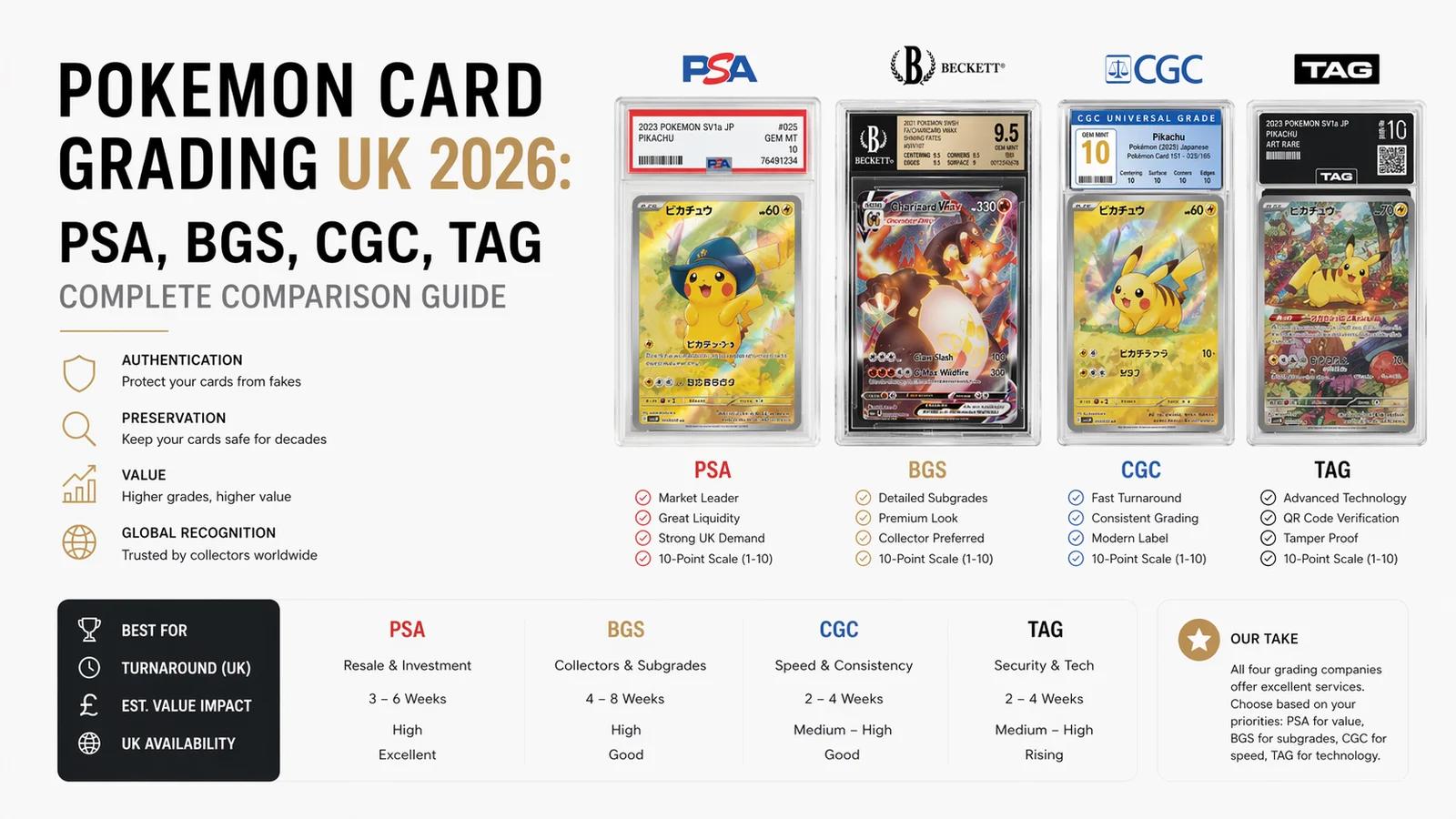
Pokemon Card Grading UK 2026: PSA, BGS, CGC and TAG Grading Complete Comparison Guide
Apr 23, 2026·Marcin

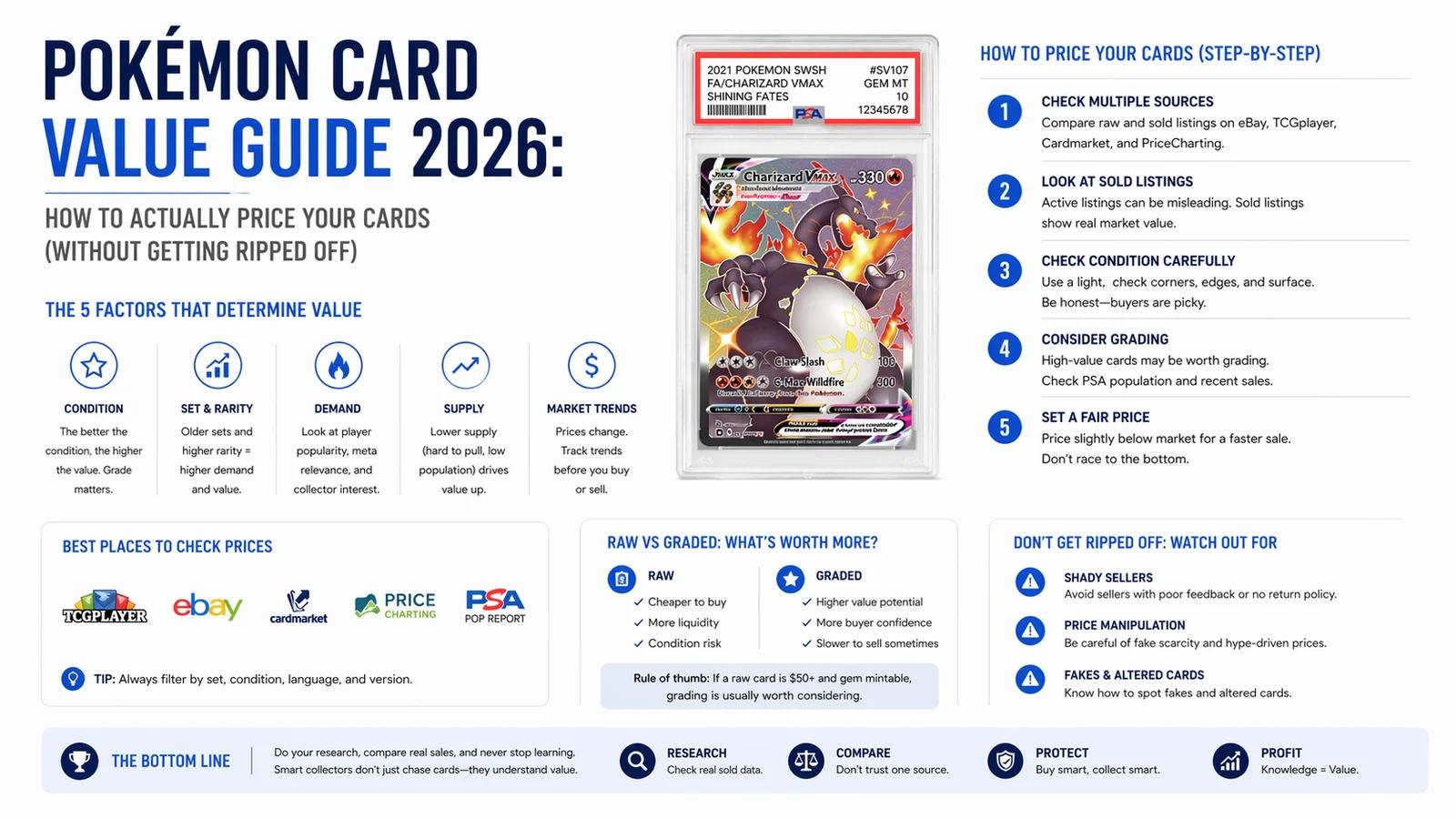
Pokémon card value guide 2026: pricing tools ranked, raw vs graded math, 6 factors that set value.
Marcin
A Pokémon card's value is a range, not a single price. Where your card lands depends on six factors: set, rarity, condition, grading, print run, and meta relevance.
Best pricing tools in 2026: TCGplayer Market Price (US), Cardmarket Trend (EU), eBay sold listings (both). PriceCharting for historical trajectories.
Raw vs PSA 10 multipliers: modern chase cards typically 3x to 8x. Vintage Base Set can hit 15x to 40x.
Seller's cut matters more than most pricing articles mention: eBay 13%, Cardmarket 5% + payment processing, TCGplayer 10%, local shops 40 to 60%.
People search this question expecting a lookup tool. Scan the card, get a number, done. Every 72 hours, a new AI tool promises exactly that. None of them work.
The reason: Pokémon card pricing is a spread. A Charizard ex SR from Obsidian Flames can sell for $80 on TCGplayer, $95 on Cardmarket EU, $70 in a Facebook trade group, $120 at a card show, and $180 if graded PSA 10. All of those are correct prices for the same card, at the same time, in different contexts.
If you want to price your cards accurately in 2026, you need to understand what sets those contexts apart. That's what this guide covers. At the end, you can price any card in your binder within a 10% range. Which is close enough for every decision except grading.
Last updated April 21, 2026. Market data verified against TCGplayer, Cardmarket, PSA Population, and eBay completed listings.
Ignore the "top 10 most expensive cards" listicles. What matters for pricing your collection is the framework. Every card is a function of these six inputs.
The set determines print run, age, and collector demand. Four tiers matter in 2026:
Vintage (1998 to 2003): Base Set, Jungle, Fossil, Team Rocket, Neo series, e-Card series. Highest collector premium because most cards were played, destroyed, or thrown out. Survivorship bias drives prices.
WoTC era eBay residual (2003 to 2007): EX series under Nintendo. Underappreciated, slow climbers.
Modern "hit era" (2016 to 2022): Evolutions, Hidden Fates, Shining Fates, Evolving Skies, Lost Origin. The pandemic-era boom sets. Evolving Skies specifically is still a top-5 liquid modern set because of Alt Arts.
SWSH + Scarlet/Violet era (2022 to 2026): Brilliant Stars, Silver Tempest, Crown Zenith, Paldea Evolved, Obsidian Flames, Paradox Rift, Paldean Fates, Temporal Forces, Twilight Masquerade, Shrouded Fable, Stellar Crown, Surging Sparks, Prismatic Evolutions, Journey Together, Destined Rivals, and Crazy Moon (the April 2026 set).
Scarlet/Violet era Alt Arts are still the most liquid modern segment. Crown Zenith and Prismatic Evolutions have collector cache.
The modern rarity stack, highest to lowest collector value:
Secret Rare (SIR) / Hyper Rare (gold texture, above set number)
Special Art Rare (SAR) (full art with expanded scene)
Illustration Rare (IR) (anime-style full art)
Ultra Rare (shiny, V / VMAX / ex)
Double Rare (basic ex, V)
Rare Holo
Rare
Uncommon / Common
Within a set, a Special Art Rare typically trades at 3 to 10x the Ultra Rare of the same Pokémon. Secret/Hyper Rares can go higher on chase Pokémon (Charizard, Pikachu, Mewtwo, Umbreon).
Four practical tiers:
Mint / Near Mint (NM): sharp corners, no whitening, centered 55/45 or better
Lightly Played (LP): minor edge wear, no creases
Moderately Played (MP): visible scratches, softened corners, still presentable
Heavily Played / Damaged: creases, major whitening, writing
Modern card pricing on TCGplayer and Cardmarket assumes NM unless stated. LP typically trades at 85 to 90% of NM. MP at 60 to 70%. HP at 30 to 50%.
Vintage grading is stricter. A "NM" Base Set Charizard in 2026 means no visible wear and centering within 60/40. Anything worse, you price as LP or below.
A graded card with a slab is a different product than a raw card. Three grading services dominate:
PSA (largest, most liquid, highest multipliers on vintage and chase modern)
BGS (Beckett) (collector favorite for tight collectors, Black Label 10 is the pinnacle)
CGC (fastest turnaround, growing trust, subgrades visible on slab)
Numbers are mid-market from Pricecharting and eBay sold listings, April 2026.
Most modern sets are printed to demand. Crown Zenith, Shining Fates, Prismatic Evolutions, and a handful of Japanese-only sets (Shiny Treasure ex, VSTAR Universe) had constrained print runs and sustained price floors. Most other modern sets were printed heavily in 2023 to 2025, so prices stay flat or soften 12 months after release.
Vintage print runs are documented. 1st Edition Base Set had roughly 11,000 of each rare printed. Shadowless Base had maybe 60,000. These numbers drive the vintage market's scarcity premium.
Meta matters for a subset of cards that see Standard or Expanded play. Cards like Gardevoir ex, Charizard ex (Obsidian Flames), Iron Hands ex, Miraidon ex have both collector and competitive demand. When they rotate out of Standard, competitive demand drops, prices correct 20 to 40%.
If you are pricing competitive cards, know the rotation schedule: 2026 rotation (Scarlet/Violet era cards rotate out) happens in April 2027. Most SV base set singles will correct significantly in mid-2026 as players unload playsets.
Not all "price checker" tools are equal. Here is the hierarchy.
TCGplayer Market Price (US-focused): live marketplace data, 30-day moving average, the single most-referenced US price. Access free via tcgplayer.com, or at scale via their developer API.
Cardmarket Trend (EU-focused): similar concept, EU marketplace. Cardmarket's "Trend" is a 30-day moving average of actual sales. "Low" is the lowest active listing. Use Trend for pricing, Low for shopping.
eBay sold listings (global): truth at the margin. Filter to "sold" listings only, last 60 days, your card's exact print. Often differs from TCGplayer or Cardmarket by 10 to 30% for graded cards.
PriceCharting: historical pricing, graded and ungraded, good for seeing trajectory. Weaker for current prices (data lags).
PokémonPrice (mobile app): scans physical cards, pulls TCGplayer + eBay. Decent for quick checks, not for serious valuations.
PokeData / PokeRev: community-maintained. Useful for Japanese exclusives.
TCG Player individual listings: show what sellers are asking, not what cards are selling for. Ignore unless you are actually buying at that price.
"AI-powered" valuation apps: most of them scrape TCGplayer poorly and don't handle grading or set variants. Skip.
Facebook group prices: useful for trade negotiation, not for objective value.
When does it make sense to submit a raw card for grading? Run the numbers before shipping.
TierPrice per cardTurnaroundEconomy ($500 declared value max)$2545 business daysRegular ($1500 max)$5020 business daysExpress ($2500 max)$10010 business daysSuper Express ($5000 max)$2005 business daysWalk-through ($10000+ max)$4003 business days
Plus shipping to PSA (roughly $20 domestic US, $60 from EU including declared value insurance), plus return shipping ($15 to $40), plus handling fees.
Total realistic cost for a single Economy submission from Europe: $45 (grading) + $60 (ship there) + $20 (return prorated in bulk) = $125 per card for a one-off. That drops to about $35 to $50 per card when submitting in bulks of 20+.
You only make money on grading if:
PSA 10 price minus (raw purchase price + grading cost + shipping) > 0
Break-even examples at April 2026 prices:
CardRaw priceGrading cost (bulk)PSA 10 pricePSA 9 priceNet profit on PSA 10Probability of PSA 10 (rough)Charizard ex SAR$85$40$340$160$21530 to 40%Moonbreon$450$40$1800$700$131025 to 35%Iono SR$110$40$440$180$29030 to 40%Giratina V Alt Art$220$40$750$340$49025 to 35%Base Set Charizard (played)$380$50$6500$1400$60705 to 10% (vintage 10 is hard)
Expected value calculation for a Charizard SAR submission:
EV = (probability PSA 10 × PSA 10 net) + (probability PSA 9 × PSA 9 net) + (probability PSA 8 or lower × loss)
With 35% PSA 10, 45% PSA 9, 20% PSA 8 or lower: EV = (0.35 × $215) + (0.45 × $35) + (0.20 × $-20) = $75 + $16 - $4 = $87
Positive. Worth grading on a bulk submission.
Raw card under $30: grading cost almost never clears
Card with visible edge wear or corner whitening: PSA 9 at best, usually 8
Cards with known centering issues (many Charizard VMAX prints): high chance of 9 even if surface is clean
Competitive cards soon to rotate: demand will drop before the slab comes back
If you are valuing to sell, subtract the platform fee from the market price.
PlatformFee to sellerPayment processingEffective cuteBay (US)13.25%2.9% + $0.30~15.5%eBay (UK/EU)12% + £0.30varies13 to 14%TCGplayer Direct9.95%2.5% + $0.30~13%TCGplayer Marketplace8.95%standard~11.5%Cardmarket5%~3% (PayPal)~8%Whatnot (live auction)8%2.9%~11%Local card shop40 to 60%0%40 to 60%Facebook groups / Discord0%0% (PP F&F risky)Risk-dependent
Example: a Moonbreon at $450 market, sold through different channels, what you actually receive:
eBay US: $380
TCGplayer Marketplace: $398
Cardmarket: $414
Local shop (60% of book): $270
FB group F&F: $450 (but no buyer protection)
Same card. $180 spread in net proceeds. Know this before you commit.
If you are pricing to buy, the math inverts. You want cards under market, and you want to minimize fees on your end.
Cardmarket (EU buyers): sellers compete fiercely, Low prices often 15 to 25% below TCGplayer.
TCGplayer Marketplace: filter by lowest price, check condition comments. 5% cashback via Soleback applies on top of any price you find.
Whatnot / live auctions: if you have discipline, you can get 30% under market. If you don't, you'll pay 30% over.
Local card shops in off-seasons: a winter trip to an LGS often clears inventory at discount.
Japanese sources (buyee, zenmarket): for Japanese exclusives, shipping kills most of the advantage unless buying bulk.
How do I know if my card is first edition? Look for the "1st Edition" stamp on the left side of the card art (vintage only). For modern Japanese sets, look for the "First Edition" text and date code on the back. English modern sets don't have first edition prints.
Is the stamped holo promo worth more than the regular? Usually yes, but depends on the promo. Staff Prerelease stamps trade at 1.5 to 3x the unstamped version. Pokémon Center stamps trade at 1.2 to 2x. World Championship stamps trade at 5 to 20x.
What's the most reliable quick-price method? Open Cardmarket in one tab and eBay sold listings in another. Compare Cardmarket Trend with the last 10 eBay sold prices. If they agree within 15%, that's your price. If they diverge, the truth is somewhere between.
Should I grade my Moonbreon? Depends on the raw condition. Under a loupe, if centering is 55/45 or tighter and corners are sharp, submit bulk. If centering is worse or any corner shows whitening, keep it raw or ship to CGC (more lenient on centering).
Does Cardmarket pricing include shipping? No. Cardmarket prices are card-only. Shipping is added at checkout based on the seller's profile (usually €1 to €6 domestic, €3 to €12 cross-border in EU).
If you are valuing a collection to sell: price each card on the lower of (TCGplayer Market, Cardmarket Trend), subtract the platform fee, and that's your realistic net. If you are valuing to insure: use the higher of those two, because replacement cost includes the markup.
If you are valuing to grade: run the expected value calculation using PSA 10 price, PSA 9 price, and a realistic probability. Anything under $30 raw usually doesn't clear.
Pricing cards is not hard once you understand the six factors. It just takes discipline, and the willingness to trust sold data over ask data.


Save on your next purchase
Browse our partner stores for cashback deals and voucher codes
Marcin
Author