Decathlon
Sport
2%

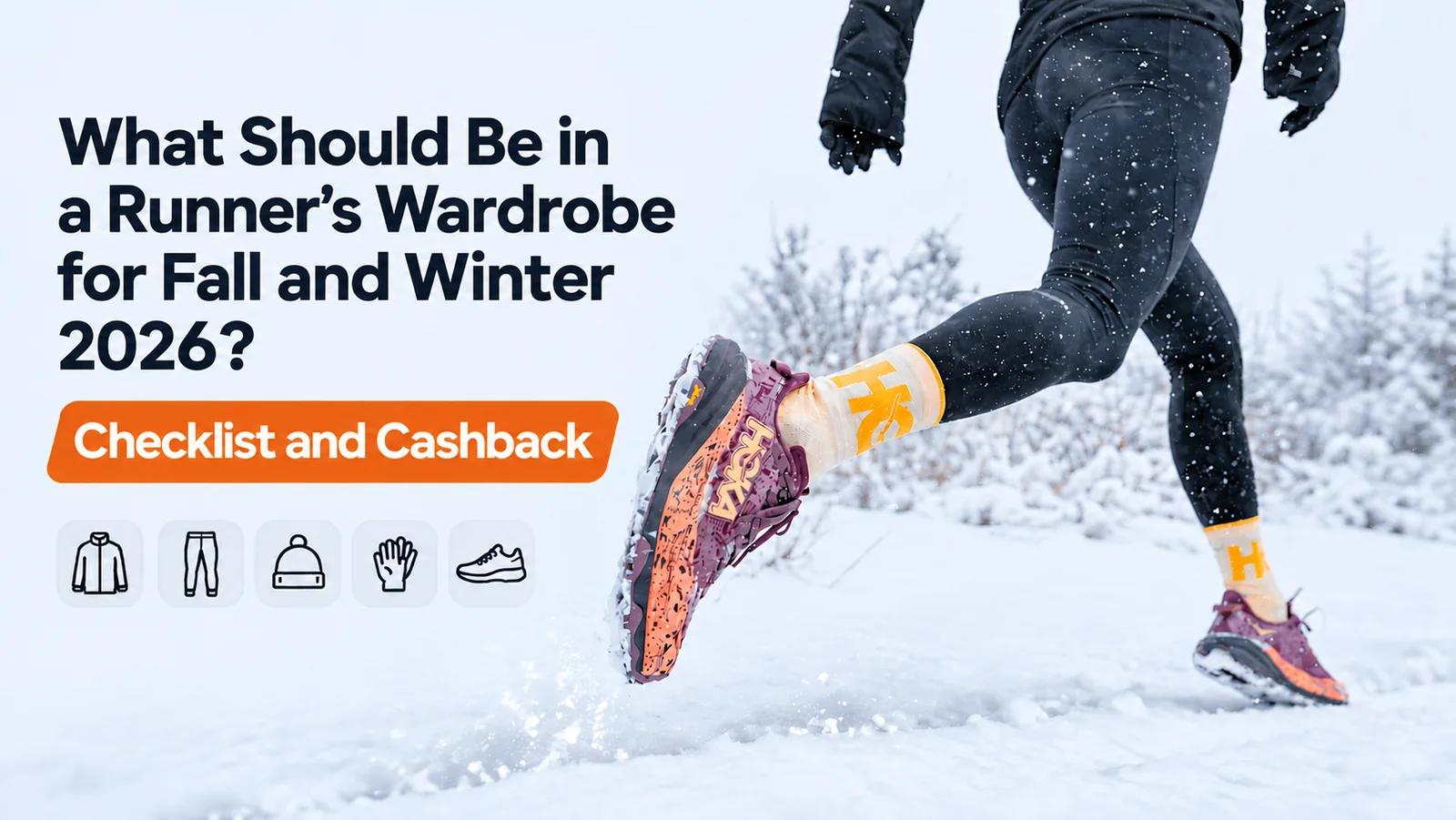
What a runner needs in autumn and winter, with no product prices but with the UK partner stores and cashback of up to 4% (rates read on 16 November 2026).
Olivia
In autumn and winter 2026 a runner needs a few thin layers, shoes matched to the surface and three items that make you visible. We do not quote product prices, because they change faster than an article does. Instead we describe what to look for and point to the partner stores in the UK where you can check current prices yourself. Through Soleback you get back up to 4% at ASICS, 3.5% at JD Sports, 2.5% at New Balance and 0.5% at Sports Direct (rates from the store cards, read on 16 November 2026). We did not check free-delivery thresholds in these stores, so we do not quote them.
Note: this article contains Soleback affiliate links, for which we may receive a commission, and we pass part of it on to you as cashback.
The Polish-language guides from Decathlon and Sportano recommend layering, meaning several thin items instead of one thick one. Decathlon counts three layers at low temperatures and allows you to skip the last one at around +5 °C. The same guide warns that above 10 °C it is easy to overheat, and that after dark the temperature can drop faster than you expect.
Foreign guides give a simple conversion: when running you feel a temperature about 5 °C higher than the forecast. Brooks puts the felt temperature at around 10 °C when the forecast is 5 °C or lower. Wind matters too, because it lowers the felt temperature.
In practice that means: dress as if it were a few degrees warmer than your weather app says, and if you are not slightly cold when you step outside, you are probably overdressed. Radio Kraków reminds runners that feeling chilly at the start is normal, because the body warms up after a few minutes.
Sportano recommends technical thermal underwear as the first layer and advises against cotton, which soaks up sweat quickly and dries slowly. For freezing days the same guide suggests thermal tights under running trousers.
This is the cheapest layer to check in your own wardrobe: if you own a cotton T-shirt, do not wear it under a jacket for a longer run. Decathlon notes that at around 5 °C a synthetic fabric such as polyester or polyamide is an alternative to merino wool, because it also wicks moisture and dries quickly.
The Polish site 8a.pl notes in its winter running guide that in summer and in dry autumn weather you can manage without a jacket, but in winter it is hard to run without one. A membrane jacket helps when it rains or snows.
Our conclusion: for most autumn runs a light windproof over a long-sleeve is enough, and you should buy a rain jacket only when you really run in the rain. You will find current ranges and prices in the partner stores listed below.
The sources disagree about legs: a Salomon guide says that at 0-5 °C shorts are often enough, because legs are less sensitive to cold and damp, while Decathlon recommends tights in winter. Our conclusion: if you run for more than half an hour or the wind is up, insulated tights are a safer choice than shorts.
Decathlon stresses that a lot of heat escapes through the head, and that a thin technical hat can be tucked into a pocket when you warm up. Gloves and neck warmers are the next items to add as it gets colder. Decathlon does not treat a headband as a replacement for a hat in frost: it protects mainly the ears and sinuses and suits warmer days better.
Decathlon gives its own split of running socks by temperature:
Sportano adds that in difficult conditions thermal socks or gaiters help, because they keep mud and snow out of the shoe.
Sportano says winter running shoes have a membrane (for example GORE-TEX) or a hydrophobic DWR coating, reinforced toe and heel areas and reflective elements. According to the store cards in Soleback, the partner stores below stock brands such as ASICS, Hoka, On Running and New Balance. We did not check which models have a GTX membrane and we did not read shoe prices, so we do not quote them.
The guides disagree on how important a membrane is. A foreign running-shoe retailer says waterproof shoes should be a must for winter, while the Polish 8a.pl writes that on dry tarmac clothing matters more than shoes in winter, and a membrane helps in rain and snow.
Our conclusion, not a measured value: if most of your routes are wet, buy a GTX model; if you run on dry tarmac, normal shoes plus good socks are enough. A membrane improves protection from water outside, but it will not dry the shoe once water gets in from the top.
We did not check the rules for pedestrians and runners in the UK, so we do not claim any legal obligation. The sources agree on the practical side. Sportano points out that light-coloured clothing is an addition to visibility, not a replacement for reflectors. Decathlon advises wearing reflective bands on the arm and leg on the traffic side, because moving limbs catch a driver's eye.
We did not check whether cashback covers items sold by third-party sellers on marketplaces. If cashback matters to you, choose items sold by the store itself.
Decathlon divides headtorches by power: around 100-300 lumens is enough in town and on shorter workouts, 300-600 lumens is the all-round option, and above 600 lumens helps in a dark forest. Sportano gives 100-150 lumens for well-lit city routes and 100-200 lumens for poorly lit ones, with a range of at least 50-70 metres.
Our conclusion: treat a light below 100 lumens as a signal light, not as route lighting, because that is the lower limit both guides recommend for city running. For city running 120-250 lumens is enough. A small flashing light that you clip to clothing is a useful addition.
These are the stores from our UK programme where you can buy running gear with cashback. Check prices on the store sites, because we do not quote them:
You will find the full list of partner stores on the page Soleback partner stores.
Rates from the store cards in Soleback, read on 16 November 2026. The cards show last-update dates from 16 April to 16 November 2026, so treat the rates as base rates and check them before you buy:
Conditions common to these cards: tracking usually within 1-48 hours, approval after 60-90 days at JD Sports and ASICS (30-90 days at New Balance, 60-120 days at Sports Direct), minimum payout of 5 euros, and a claim for missing cashback within 28 days. Soleback has more than 740 partner stores.
Cashback will not be credited in these cases:
After you land in the store, accept the cookie consent, because the ASICS card warns that if you reject it, cashback may not be credited. The browser extension makes activation easier by reminding you about cashback on store sites: Soleback extension. If something is unclear, ask in the Soleback help centre before you buy.
Both examples are hypothetical and based on the rates from the store cards. We chose the basket values for easy arithmetic.
First example, a basket of £200 at JD Sports: cashback of 3.5% is about £7.00. The JD Sports card lists a code for 10% off for students, on full-price and sale items, with no expiry date. If the code applies, the basket falls to £180, you save £20, and cashback of 3.5% on £180 is about £6.30, so about £26.30 in total. We did not check whether cashback is calculated on the price after the discount.
Second example, a basket of £150 at ASICS or at Sports Direct: at ASICS up to 4% is about £6.00, at Sports Direct 0.5% is about £0.75. The same spending earns eight times more at ASICS, so compare the rates before you choose a store, but only if the product you want is available in both.
The information below comes from the store cards on the day of reading. Some offers are short-lived, so check that they still work before you buy:
You will find the full list of current codes in the vouchers section and current offers in the promotions section.
Black Friday falls on 27 November 2026. None of the four store cards listed a Black Friday promotion when we read them, and we did not check the stores' own sites for announcements.
Our conclusion, without checked prices: waiting is worth it mainly for the more expensive items, meaning shoes and a membrane jacket, while basics such as a hat, a light or reflectors are better bought straight away if you need them now. The risk of waiting is that sizes disappear first, and some promotions last only while stock remains.
Five discrepancies that we found:
Before you order, activate cashback on the card of the store where you are buying, for example ASICS or JD Sports, buy in the same session at ASICS or at JD Sports, and then look at the promotions and the help centre. You will find all cashback stores for the UK on the page Soleback partner stores.



Save on your next purchase
Browse our partner stores for cashback deals and voucher codes
Olivia
Author