Reebok
Fashion
4%

Flat sole, cross-trainer or weightlifting shoe. How to match the type to your training
Soleback Team
The commonest beginner error is not picking the wrong model but picking the wrong category. If you squat in running shoes, you are fighting your own footwear. Below are the three types of training shoe, with a clear steer on when each makes sense.
Do not lift in running shoes. A soft sole compresses under load and takes your stability with it
A flat sole is enough for around ninety percent of lifters. Converse are a staple for a reason
Cross-training shoes suit anyone combining weights with classes and HIIT
A raised, firm heel is a specialist tool. Buy it when squatting becomes your priority, not before
On most training plans a single pair is all you need
Start with what to stop doing, because this is the most common kit error among beginners.
Running shoes are built to absorb impact and push you forward. They are excellent over five kilometres and poor under a heavy squat.
The reason is mechanical. Under load, a soft cushioned heel compresses unevenly and shifts. Instead of driving through a stable base, you are balancing on a mattress. The force your legs generate gets absorbed by foam rather than going into the bar.
For lifting you want the opposite: a flat, firm, stable platform.
Who it suits: everyone starting out, and anyone training mainly for strength.
The rule is simple and worth remembering: for around ninety percent of lifters, a flat firm shoe is enough forever.
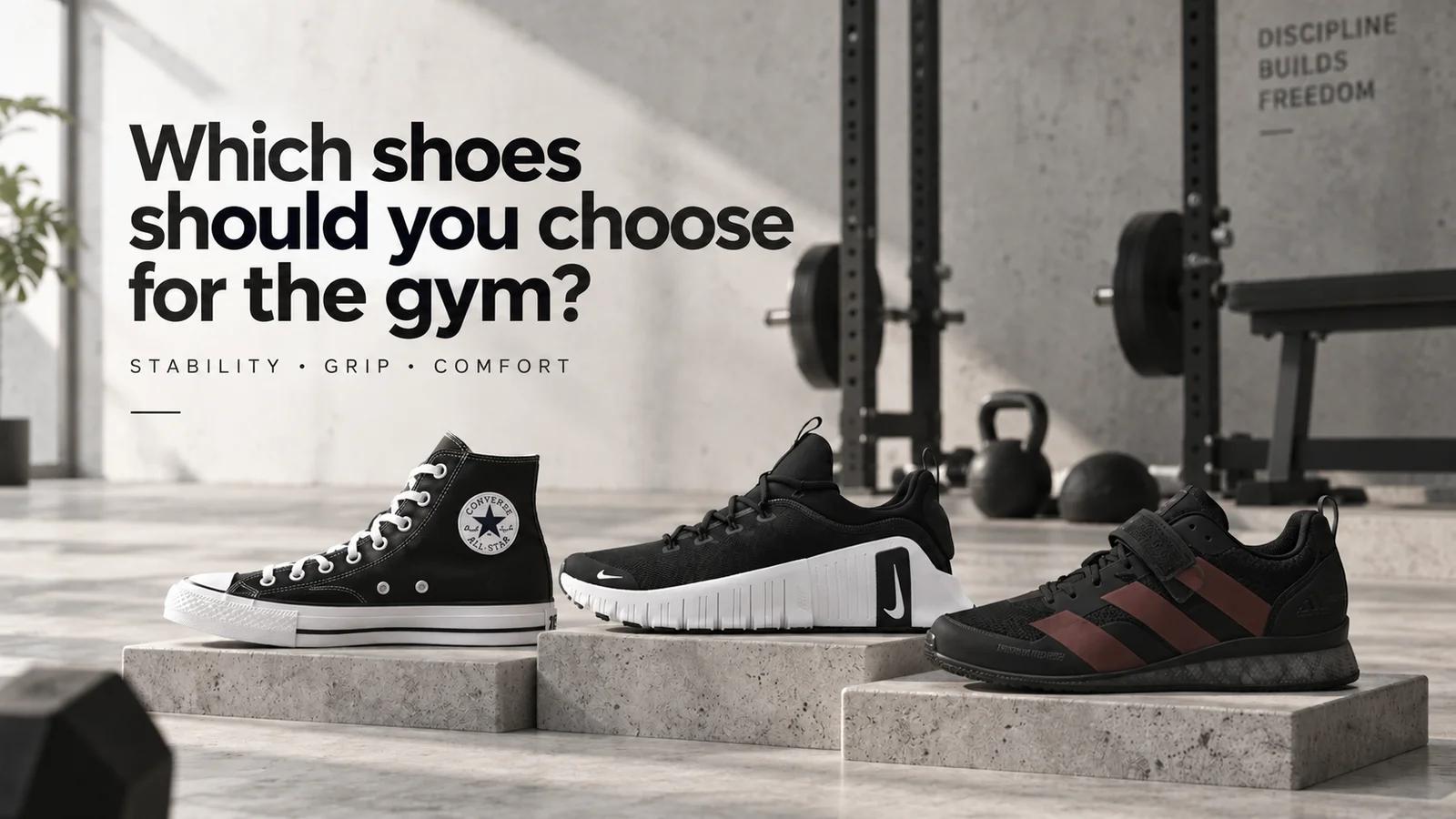
Converse Chuck Taylors have been a powerlifting staple for decades for exactly this reason: a dead-flat sole, firm, and cheap. For deadlifts, squats and bench, that is all you need.
The category also covers barefoot-style shoes like the Vivobarefoot Motus Flex, with a wide toe box, an ultra-thin sole and a flexible upper. They give maximum ground feel and a stable base for compound lifts.
The downside: no cushioning means they are uncomfortable on longer runs or heavy jumping, particularly if you are not adapted to them.
Who it suits: anyone combining weights with classes, HIIT and short cardio.
The Nike Metcon is the reference point here, because the line prioritises stability and control over adding cushioning. A rubber sole, breathable mesh upper and moderate cushioning make it suitable for weights, circuits and general strength work.
The flat heel makes it convincing for lifting, while the upper and cushioning make it more comfortable than very minimalist shoes over longer sessions.
The NOBULL Drive Ripstop is for anyone who genuinely runs in their training shoes. A thicker, responsive Pebax midsole, a 4mm drop and a lightweight ripstop upper give a shoe that is comfortable running and doing plyometrics while staying stable under light to moderate loads.
The downside of the whole category: these are compromise shoes. Because they have to balance several activities, they will not match purpose-built kit at any one of them. For longer distances you still need running shoes.
Who it suits: anyone whose squat and Olympic lifts are the main focus.
A raised, firm heel lets you hit a deeper squat and stay more upright. On cleans and snatches it is rock-solid. The adidas Adipower is the model most often cited.
This is a specialist tool, though, and should not be a first purchase. Buy it when squatting becomes your programme's priority and ankle mobility turns out to be the limiter.
The downside: outside squatting and Olympic lifting the shoe gets in the way. For machines, cardio and unilateral work it is awkward.
A flat sole for lifting. This criterion is the most important and non-negotiable. The less foam between foot and floor, the more force reaches the bar.
Traction. A non-slip sole is a safety requirement on lunges, deadlifts and single-leg work.
Breathability. Good ventilation reduces the risk of blisters, which on several sessions a week translates into comfort.
Durability. Materials and construction have to survive regular loading, and training shoes wear differently from running ones, mostly at the sides.
Toe box width. Under load your toes should have room to splay. That affects stability more than people expect.
Drop, the heel-to-toe height difference. For lifting you want low figures, zero to four millimetres. The higher it goes, the closer the shoe gets to a running model.
A simplified rule that covers most cases:
Just starting? Flat sole. Converse or any cheap shoe with a firm base
Weights plus classes or HIIT? Cross-training, a Metcon or similar
Heavy squats and Olympic lifts your main goal? A weightlifting shoe with a raised heel
Running a lot on the treadmill? Separate running shoes rather than a compromise
Most people never need to go beyond the first point.
Worth stating, even though it does not sell shoes.
A cheap pair of flat shoes and a gym where someone checks your form beats expensive kit and no coaching. Shoes are a tool here rather than a solution, and most stability problems come down to technique or mobility rather than footwear.
If you are starting out, spend less on shoes and put the difference towards a few sessions with a coach.
The retailers below stock training and sports footwear, and buying through Soleback returns part of the order value:
The click through Soleback has to be the last one before the shop, and cashback clears once the returns window closes.
Comparing a few shops is worth it, because on training shoes the price gap between retailers can be substantial on the same model.
Our promotions section is worth checking too, since training shoes tend to drop in price outside the January peak.
For cardio and machines yes, for weights no. A soft heel compresses under load and removes stability, which on squats and deadlifts feeds directly into your numbers.
Almost certainly not at the start. They are a tool for people whose squat and Olympic lifts are the main goal and whose limiter is ankle mobility.
On most plans yes. If you regularly run longer distances, though, you need a second pair, because no training shoe substitutes for that.
They have a lower drop, a flat and firmer sole and side reinforcement, giving stability on multi-directional movement. Running shoes prioritise cushioning and forward propulsion.
For strength training yes, since they give a flat base and maximum ground feel. On jumping and longer cardio they can be uncomfortable, especially without an adaptation period.
Less often than running shoes, because it is not cushioning that wears out but the tread and the sides of the upper. The signal is lost traction and a stretched upper.
The choice is simpler than the number of models on the market suggests. If you train for strength, you need a flat firm sole, and that is it. Converse have been doing that job for decades.
If your training is mixed, a Metcon or similar cross-trainer covers the gym, classes and short cardio, on the understanding that longer runs need something else.
And leave the weightlifting shoe for the point where squatting becomes your number one goal. Bought too early, it will only get in the way.

Save on your next purchase
Browse our partner stores for cashback deals and voucher codes
Soleback Team
Author