
KAWS x UNIQLO: the KAWS UNIVERSE collection has landed
Sep 17, 2026·Soleback Team

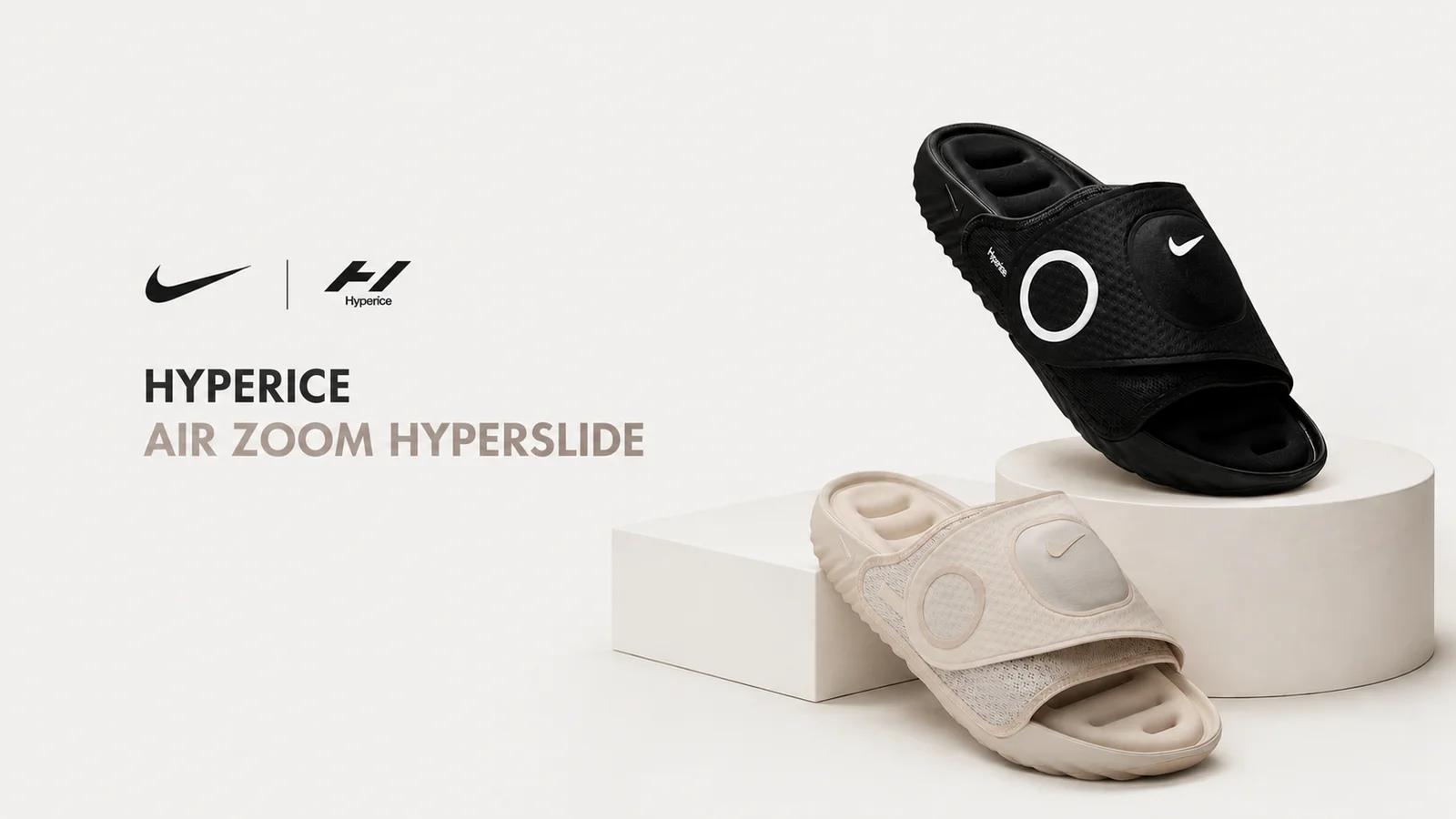
A module in the strap, Air Zoom underfoot and a price a quarter of the Hyperboot's
Soleback Team
The second joint product from Nike and Hyperice, this time at $249 rather than $899
Releasing 29 September 2026 through nike.com, hyperice.com and selected retail partners
The heat and vibration module sits in the strap, not the sole, and works on the top of the foot
Three heat levels up to 47C, three vibration levels and fifteen minute cycles
Unisex sizing, two colourways, and the product is TSA approved for air travel
The core of the design is the Hyperslide Pod, a removable module held magnetically inside the slide's adjustable strap.
One recurring error is worth correcting straight away: the pod is not in the sole and does not work from underneath the foot. It sits in the strap and acts on the top of the foot, exactly as Nike's release describes.
Module specifications:
three heat levels, up to 47C or 117F
three vibration levels
fifteen minute treatment cycles
controls on the pod itself or through the Hyperice app over Bluetooth
around an hour of use per charge, meaning roughly four sessions
USB-C charging, with a full cycle taking around three hours
The technology descends from the Venom line, Hyperice's existing family of products combining heat and vibration.
Underfoot sits a full-length, low-profile Nike Air Zoom unit. A technical curiosity: Nike deliberately lowered its pressure. In running or basketball shoes, Air Zoom units run at higher pressure to return energy with every step. Here the priority is softness rather than responsiveness.
The unit does a second job too, conducting heat and vibration from the module rather than damping them.
The rest of the build comes down to an adjustable textile strap, an LED-lit branding element and a textured rubber outsole with concentric traction rings and a debossed Swoosh.
Black, style code 66000-001. A dark base with white Nike branding that stands sharply against it.
Orewood Brown, style code 66005-001. The tonal version, in shades of beige and sand, where the logo nearly melts into the upper. The quieter of the two.
Both in unisex sizing.
This is the most interesting thread in the whole launch. The partnership's first product was the Hyperboot, a high-top released in 2025 combining pneumatic compression with heating, priced at $899. Impressive technology, but in practice a product only a handful of people reached for.
The Hyperslide answers that problem. Compression disappears entirely, heat stays, vibration is added, and the price drops to roughly a quarter.
Who led the project changed as well. The Hyperboot was driven mainly by Hyperice, which wanted its tools in a more mobile package. On the Hyperslide, Nike took the wheel, with the brief of building the best possible version of a slide.
Anthony Katz, Hyperice's founder, explained the approach to Footwear News: the aim was to find the point where an expensive slide still makes sense as a value proposition, meaning the most comfortable version of the form, with a little technology and the versatility to wear it in a lot of situations.
Tobie Hatfield, Senior Director of Athlete Innovation at Nike, frames the goal differently: a solution that kickstarts recovery the moment you power it up. Virgil van Dijk is among the athletes named as testing the product.
Model: Nike x Hyperice Air Zoom Hyperslide
Colourways: Black, style code 66000-001, and Orewood Brown, style code 66005-001
Price: $249, though some outlets round it to $250
Release: 29 September 2026
Sold through: nike.com, hyperice.com and selected retail partners
Nike refers to select markets and select retail locations globally, but has not published the full list of countries. In the US the model additionally reaches Best Buy and Dick's Sporting Goods, and that choice of partners says plenty about the positioning: closer to consumer electronics than to a shoe wall.
An American nuance: Hyperice states the purchase qualifies for FSA and HSA funds, the US health spending accounts. It means nothing for a UK buyer, but it shows how the brand classifies the product.
The gaps in the official communication are worth noting. Nike has not stated water resistance or the full list of markets covered by the September launch. Battery life and charge time only appeared in Hyperice's comments and trade coverage, outside the press release itself.
A separate point: describing heat and vibration as support for relaxation and everyday recovery is a company claim, not the result of independent clinical research. Nike does not position the slide as treatment for injury or medical conditions.
The maker is aiming broadly: athletes after training and competition, but also people on their feet all day at work or travelling. The logic is simple. Recovery stops being a separate ritual with a roller and ice, and becomes something that happens incidentally, in the footwear you were putting on after training anyway.
TSA approval reinforces the travel angle, since the module can go in hand luggage without complications.
Whether $249 for a pair of slides makes sense is a personal call. It is worth noting, though, that the figure sits close to Hyperice's standalone devices in the Venom Go line, with the difference that here the technology arrives built into footwear.
29 September 2026, through nike.com, hyperice.com and selected retail partners.
$249. No sterling or euro pricing has been announced, nor the full list of markets.
On the top of the foot. The module sits in the strap, not the sole.
Around an hour, meaning roughly four fifteen minute sessions. A full charge takes around three hours.
Yes, the product is TSA approved for air travel.
No pneumatic compression, vibration added, and a price roughly three quarters lower.
The date to watch is 29 September. Until then two things relevant to a UK buyer stay open: whether this market is among those covered by the launch, and what the sterling price will be.

Save on your next purchase
Browse our partner stores for cashback deals and voucher codes
Soleback Team
Author