Frisco.pl: delivery, discount codes, returns and Frisco Friends
Oct 2, 2026·Soleback Team

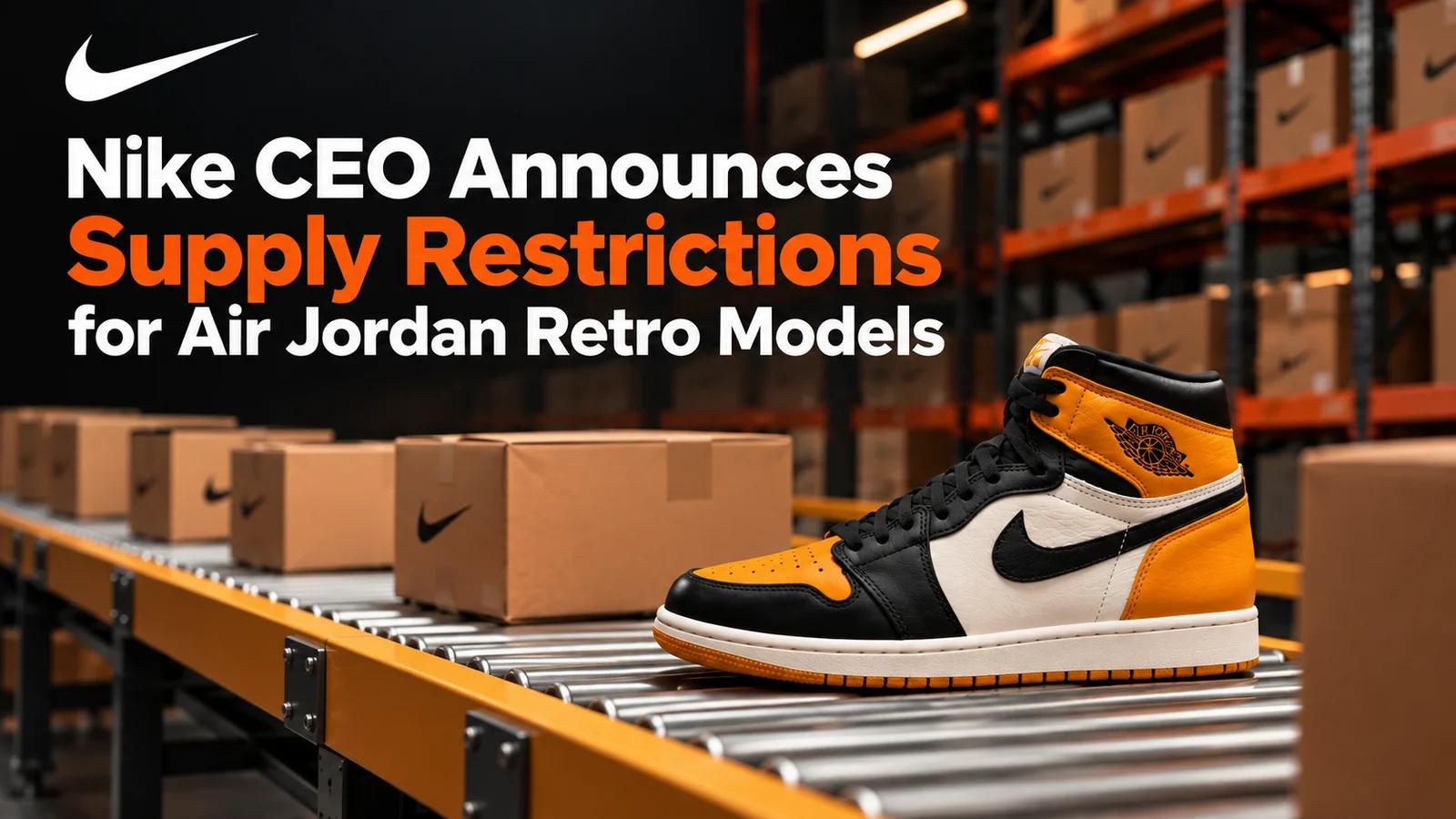
Elliott Hill admitted the oversupply. From spring 2027 there will be fewer launches, and fewer discounts with them
Soleback Team
Nike is officially restricting the supply of Air Jordan Retros. CEO Elliott Hill said it on the first quarter fiscal 2027 earnings call on 1 October 2026 in terms that leave no room for another reading: the brand will deliberately reduce the volume and frequency of specific Jordan Retro launches. The first effects are due from spring 2027.
The reason is simple and Hill named it outright. Jordan was oversupplied for years. The consequence for buyers is equally simple and rather less pleasant than it sounds in a press release. Fewer pairs means fewer discounts.
Before you buy anything, activate cashback through Soleback.
Three statements from the call add up to the whole picture.
The first is the diagnosis. Hill admitted the brand had been "oversupplying our iconic retro product, asking them to do too much". That is unusually candid for a chief executive, because it concedes that the most profitable part of the portfolio was run into the ground.
The second is the decision: "we will deliberately reduce the volume and frequency of specific Jordan Retro launches". The word that matters is deliberately. This is not a supply chain problem and not a shortage of components. It is a chosen scarcity.
The third is the justification and also the best-sounding sentence of the whole appearance: "When consumers see the Jumpman, it should feel special, it should feel earned".
Hill added that the reset should build "a foundation for more profitable and sustainable growth", and noted that North America will feel it fastest and hardest. Europe sees the consequences later, because that is how the wholesale ordering cycle works.
Without the financial context the announcement looks like brand stewardship. With the context it looks like a crisis response.
Full-year fiscal 2027 guidance calls for a revenue decline in the high single digits, with operating profit falling faster than sales. The CFO is Dave Denton.
Put two lines of that list side by side and the logic becomes obvious: margin is rising while revenue falls. Nike is deliberately choosing a smaller but healthier business over a large discounted one.
The reduction does not start today. The Air Jordan 1 Retro High has been cut back for several years already, and it is that path that will now be extended to the rest of the line-up.
For comparison, Jordan Brand currently puts out an average of about ten retro launches a month across all silhouettes. That is the number set to fall.
Nike has not published a list of affected models. What the comments do establish is that some planned launches may be pushed back, cut altogether or released in smaller quantities. The start point is spring 2027.
The strongest argument that Nike will actually do this is not a statement but a precedent from the same quarter.
Nike deliberately cut Dunk revenue by almost half. Not because nobody wanted them, but because that was the plan. The company openly described it as a planned headwind to results, a cost it accepted in order to clean up the marketplace.
If you have wondered why there are visibly fewer Dunks in shops than two years ago, that is the answer. Jordan is now going through exactly the same procedure, on a larger and more expensive part of the portfolio.
What Nike says about the model it did not cut this quarter is revealing. The Air Force 1 was described as healthy and as "driving a stable full-price business through new dimensions and seasonal materials and colors".
That is not an incidental sentence. The Air Force 1 held full price through rotating materials and versions rather than through scarcity. Jordan did not do that, and now has to catch up by brute force.
The practical conclusion for buyers: the AF1 remains a shoe you buy when you feel like it, and Jordan is ceasing to be one.
Four concrete consequences, soonest first.
Europe will feel it later than North America, because Nike cuts first where the oversupply is worst. The lag may be one or two seasons, so spring and summer 2027 will probably still bring normal availability in the UK, with the real squeeze arriving afterwards.
The most measurable proof that the current situation is abnormal is sitting on Nike's UK site today.
That list is the real article. An entire Jordan sale page running at 30 per cent across the board is exactly the symptom Hill described as the problem. Worth noting is that the base Air Jordan 1 Low is discounted here, while in France, Spain and Italy the same shoe is explicitly excluded from site promotions. The UK currently has the friendlier pricing environment.
The uncomfortable but honest conclusion: if a specific pair is on your list, the next two or three seasons are probably the last period in which discounts like these are the norm. On amounts between £80 and £165 it is also worth activating cashback, because a few per cent there is a real sum. The easiest way not to forget is the Soleback extension.
Here you have to separate the mechanism from the promise.
The mechanism is not in dispute. Less supply against constant demand raises prices on the secondary market. Falling resale prices on many Air Jordan 1 colourways were a direct consequence of saturation, so capping quantities should lift them.
The promise is less certain, because it assumes demand stays constant. The last quarter's numbers say Jordan revenue fell by mid-teens percentages. So it is not only supply that is shrinking, but interest. Restricting supply into falling demand does not create scarcity, it just creates a smaller market.
The honest forecast is therefore this: the most sought-after colourways will probably recover their premium on the secondary market, and the middle of the range will not.
The Jordan reduction is not happening in a vacuum. Nike showed in the same quarter what is growing, and that is where the attention is going.
Read alongside the Jordan cuts, the direction is clear. Nike is no longer funding growth by repeating classics and is returning to sport categories. For anyone who buys shoes to wear rather than to collect, that is broadly good news, because the P6000 and Vomero cost less than retros.
The Jordan restriction is only one element of a much wider operation. In parallel Nike announced a restructuring programme called Pace.
Hill justified it with this: "We must get closer to athletes and consumers, make decisions faster, and focus our investments on the areas that create the most value". In April 2026 Nike had already carried out layoffs affecting around 1,400 people.
The implication is that the retro cut is not a whim of the product team but part of a plan with its own budget and its own timetable. That raises the odds it actually happens.
Healthy scepticism is in order, because Nike has been talking about cleaning up the marketplace for some time. The language about restoring balance and pulling back on classics has run through the company's communication for several years, and revenue has fallen throughout.
Two things are different this time. First, the Dunk really was cut by almost half, which is hard evidence of execution rather than explanation. Second, gross margin is rising while revenue falls, so the higher-price lower-volume strategy is already showing up in the numbers.
That guarantees nothing, but it does distinguish this announcement from the previous ones.
Practical, no speculation.
Retailers where it is worth tracking Jordan availability:
New users also start with a welcome bonus, and if a rebate does not register you can raise it through the help desk.
What is missing here: a link to nike.com. There is no Nike cashback programme in our database, so buying from the official store will not generate a rebate.
Nike has publicly admitted what buyers have been saying for years: there were too many Jordans. The response is a deliberate reduction in the number and frequency of retro launches from spring 2027, prefaced by the already visible trimming of the Air Jordan 1 Retro High from 20 colourways in 2021 to 12 in 2026.
The message is written in the language of prestige but its mechanism is commercial. Nike is choosing higher margin at lower volume, because at 42.8 per cent margin and falling revenue that is the only route that improves profitability without cutting prices.
For buyers it means the end of an era in which a Jordan could be had cheaply simply because it was sitting there. If one thing should stick from this change, it is not the promise that the Jumpman will feel special again, but the plain fact that the discounts you can see today are the symptom of a problem Nike is in the middle of removing.
Save on your next purchase
Browse our partner stores for cashback deals and voucher codes
Soleback Team
Author