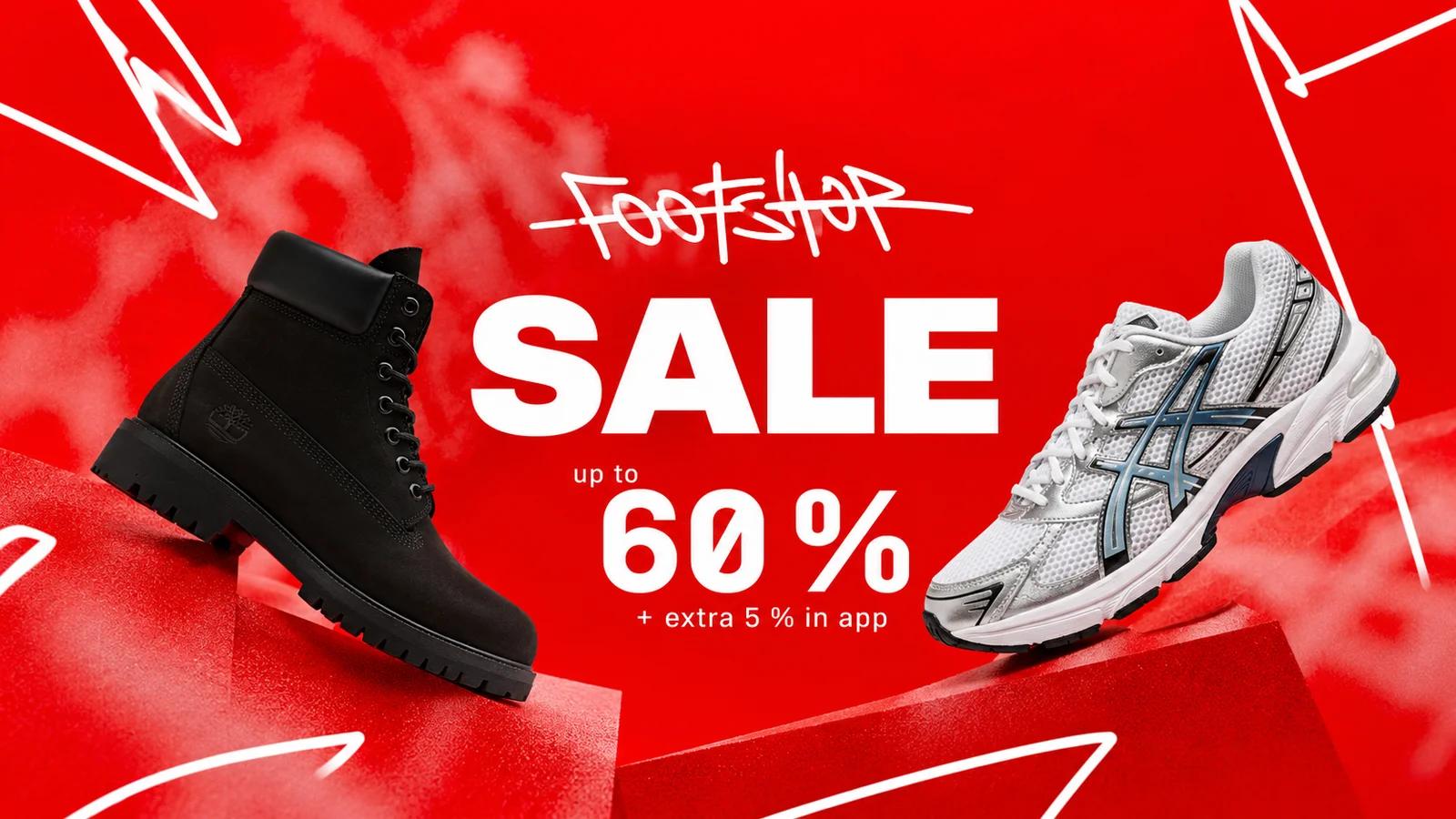
Footshop sale: up to 60% off trainers and boots
Oct 19, 2026·Soleback Team

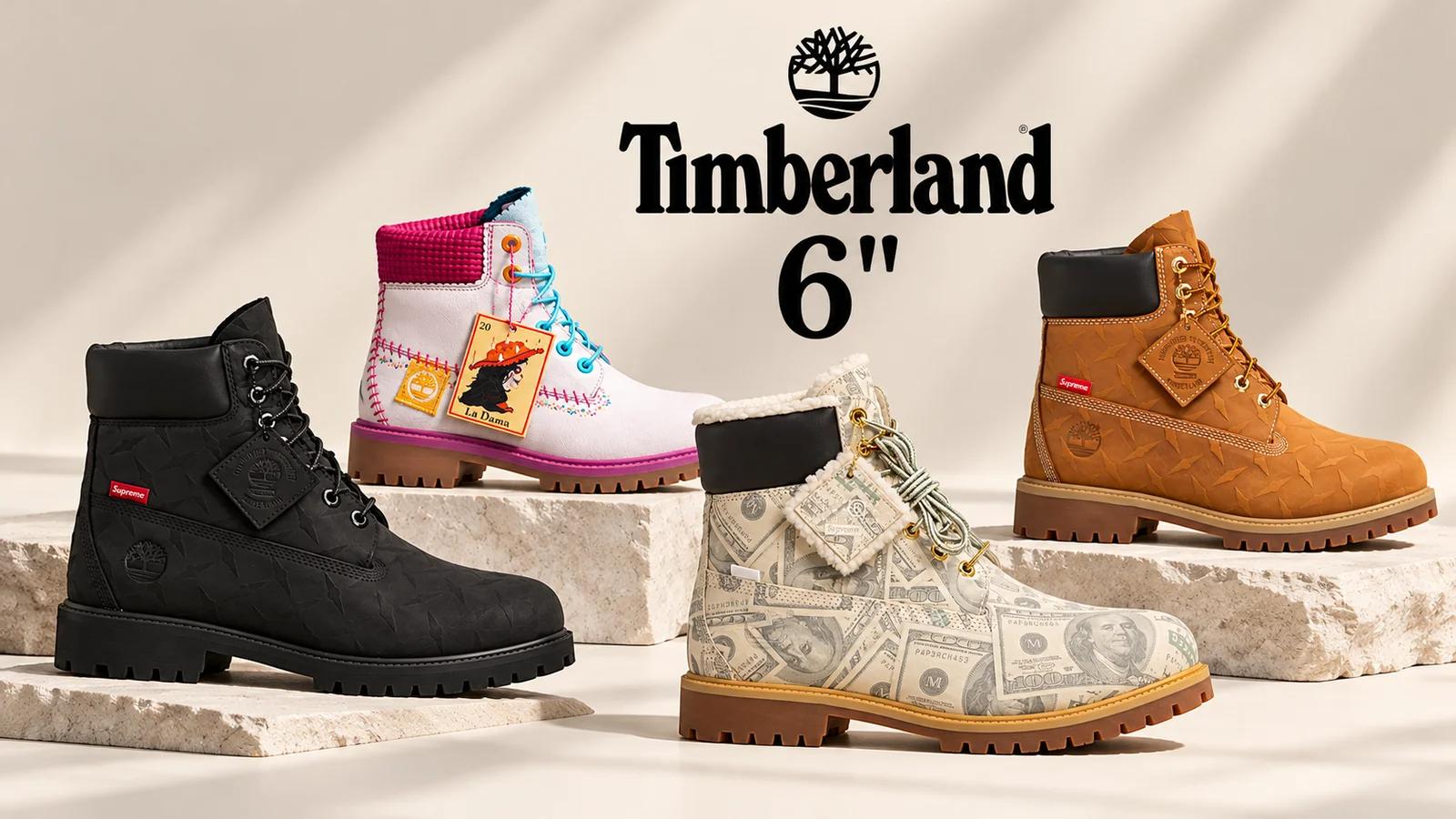
From New England building sites to 90s rap and the Louis Vuitton runway: the construction, culture and collaborations behind the Timbs, plus where to buy them in the UK.
Soleback Team
The Timberland 6-Inch, aka the “Yellow Boot”, became a global icon because it brought together three things no rival ever managed at once: a 1973 workwear build that genuinely keeps out water and cold, adoption by the streets of New York and 90s rap, and five decades of collaborations from Supreme to Louis Vuitton. In October 2026 the men's Yellow Boot costs £190.00 at full price on Timberland's official UK store (read 19 October 2026), and this year Supreme brought back its Diamond Plate model and, with MM6 Maison Margiela, released a version covered in a 100-dollar bill print.
Start with a simple test. Head out on a February day in Kraków, London or Milan and count the yellow boots with a dark collar. In plenty of cities you'll spot more of them than any other winter model. It's the same boot that New England builders bought half a century ago because they needed footwear that could survive rain, snow and a full day on the scaffolding.
The road from the building site to the Louis Vuitton runway was never planned. For years the brand designed boots for people who work outdoors, and for quite a while it didn't understand why rappers, kids from the estates and Milanese teenagers loved them. This article takes the phenomenon apart: construction, culture, business and collaborations. At the end you'll find prices read on 19 October 2026 and a pointer on what to buy depending on what you want from the boot.
The story begins with a shoemaker called Nathan Swartz. According to Timberland's official history, in 1955 he took full control of the Boston-based Abington Shoe Company. Other sources, including Wikipedia, give 1952 as the year he bought a half share. The two versions fit together: first half the company, then all of it. We stick with 1955 here, because that's the date the brand itself gives.
For years Abington made shoes for other people. The breakthrough came when the Swartz family began experimenting with a technology that was still new in work footwear.
A classic work boot has its sole stitched to the upper. Every seam means hundreds of tiny holes, and every hole is a way in for water. The Swartzes introduced injection moulding: the rubber sole is bonded to the upper without stitching, so the bottom of the boot forms one sealed unit.
Here the sources disagree again. Mr Porter says 1965, while Wikipedia links the waterproof injection-moulded boots to the company's move to Newmarket, New Hampshire, in 1969. One thing is certain: by the time the first boot with the tree logo appeared in 1973, injection moulding was already its foundation. Add to that silicone-impregnated leather, which the company describes in its own press materials.
Why does that matter to you today? Because this construction is exactly what makes the 6-Inch a boot for puddles and slush, not just for photos. Plenty of fashionable winter boots look similar but have a glued or stitched sole with no sealing.
1973 is the date every source agrees on. Less clear is exactly which boot was made that year. Timberland's official pages say the original was 8 inches tall and the 6-Inch version arrived around three years later. Mr Porter, on the other hand, writes about three variants in 1973, including a 6-inch model. CNBC and Highsnobiety simply call the 1973 boot the 6-Inch. So the safest way to put it is this: the original Timberland boot was born in 1973, and the 6-Inch is its best-known form.
The colour known as “wheat” turned out to be a happy accident. The light nubuck was easy to see in the woods and on building sites, and against a grey city it became a badge of recognition. In 1978 the company changed its name to Timberland, because boots bearing that logo already made up most of its sales. According to CNBC, citing the Boston Globe in 1983, by the end of the 70s they accounted for around 80 per cent of the company's products. Internally, the model is still known as style 10061.
According to the official product page, the current men's Premium 6-Inch Waterproof Boot in Yellow has:
Watch out for differences between versions. The UK product page for the women's black model lists 200 g of PrimaLoft insulation, not 400 g. If you're buying a women's size or a different colour, check the insulation on that specific product's page. “Waterproof” and “anti-fatigue” are the brand's claims; we found no independent tests. The figures you can actually measure are the insulation weight and the boot's weight, and 951 g for a single boot is a lot. If you mostly walk on dry pavements, you'll feel it by the end of the day.
At the turn of the 80s and 90s, a boot designed for loggers and builders landed on New York street corners. In his book “Buying In”, journalist Rob Walker describes how the first buyers were people who spent entire nights standing outside and needed footwear that would keep them warm and dry. To put it plainly: drug dealers, who in their neighbourhoods were also local style setters. Vibe magazine wrote that the boots could handle concrete, barbed wire and broken glass.
This story matters because it shows a mechanism that later worked for many other brands: function turned into style. Nobody bought Timbs because they were fashionable. They became fashionable because they worked where other boots failed. The street gave them the nicknames “Timbs” and “Butters”, and critic Nelson George called them the Air Jordans of boots.
In the 90s Timberland became something like hip-hop's unofficial uniform. A few documented examples:
There's also a detail that shows the scale of the influence: the producer Timbaland took his name from the brand. When someone builds an artistic identity around your logo, you stop selling boots and start selling belonging.
This is the most counterintuitive chapter of the story. In November 1993 the New York Times published a piece called “Out of the Woods” about Timberlands becoming essential footwear for urban youth. According to CNBC's account, then chief executive Jeffrey Swartz said that Black customers made up just 5 per cent of sales and that the brand had no intention of building its business on a passing trend. A fashion editor at The Source told the paper the brand feared that popularity in that community would damage its prestige.
The backlash was fierce. Wendy Williams called for a boycott, and in January 1994 Swartz responded in the Amsterdam News with a piece rejecting the accusation of racism. A caveat: we were unable to read the original 1993 article; we quote it via CNBC and Wikipedia.
The most interesting part is what happened next. The boycott didn't stop sales. According to Wikipedia, the controversy had no lasting effect on results. The street chose the boot regardless of what the boardroom thought of it. Full reconciliation only came years later: the 2017 campaign with Nas, the collaborations with Supreme and New Era, and the special “Hip Hop Royalty” model in February 2023.
The 90s translated into financial results that are hard to ignore. According to Trapital, Timberland's sales grew roughly ninefold between 1985 and 1994, and its share price rose 280 per cent in 1993 alone. Mr Porter, citing a New York Times profile of the company, writes about an almost 50 per cent rise in net sales between 1992 and 1993, in other words in the very year of the controversy. CNBC reports that revenue passed a billion dollars in 2000.
In 2011 Timberland was bought by the VF Corporation. Media reports give different figures, 2 or 2.3 billion dollars. Both are correct: the first is the equity value, the second the total transaction value according to VF's announcement. The brand has been growing in recent quarters: according to VF, Timberland's revenue in the quarter ending 27 June 2026 was up 4 per cent year on year.
New York is the loudest chapter, but not the only one. Timberland's official newsroom names three other scenes that adopted the yellow boot:
This matters for understanding the boot's icon status. A boot that works in only one subculture is a fashion. A boot that catches on independently in four cities on three continents becomes a classic.
If Timbs are more than 50 years old, why haven't they disappeared like so many other 90s models? We see four reasons, although this is our conclusion from the sources we gathered, not hard sales data:
In 2023 the brand marked its 50th anniversary with the Future73 project: six creatives, including Samuel Ross (A-COLD-WALL*), Edison Chen (CLOT), Nina Chanel Abney and Christopher Raeburn, reinterpreted the 6-Inch across seven drops from March to October.
Of the four candidates we started with, three are genuine collaborations. The fourth, the patent Finch Wheat in kids' sizes, turned out to be a standard colourway with no partner (details in a separate section below). In its place we picked the two partnerships with the greatest cultural weight.
Supreme has worked with Timberland for years: Sneaker Freaker points to 2006 and the Field Boot as the start, and in 2013 a 6-Inch with snakeskin-effect embossing was made for the boot's 40th anniversary. The Diamond Plate version debuted in December 2023. The nubuck is embossed with a checker plate pattern, like the steps on a lorry, and it comes with a red Supreme tab on the side and a black leather collar.
On 17 September 2026, in the autumn-winter 2026 season, Supreme brought the model back in Black and Wheat. According to Sneaker News, it's the first ever re-release of a joint model from the two brands. In Europe it was sold only through Supreme's stores and website, including London, Milan and Berlin. We couldn't find a price in pounds.
The most provocative 6-Inch of the year. It launched on 19 March 2026, in week four of Supreme's spring-summer 2026 season. The wheat nubuck was replaced with panels printed with reworked 100-dollar bills: Benjamin Franklin's portrait, Margiela's “M”, Supreme's green box logo and a line stating that the note is not legal tender. The inside is lined with shearling, the eyelets are gold and the laces are white and green.
It's a three-way collaboration, sold through Supreme and Margiela channels rather than Timberland stores. The retail price was not disclosed. The Spanish outlet Modaes called it Timberland's first luxury step, which isn't true, because Off-White, Jimmy Choo and Louis Vuitton came earlier.
Launched globally on 15 August 2026. Seven baseball teams, including the New York Yankees, Boston Red Sox and Los Angeles Dodgers, paired with 59FIFTY and 19TWENTY caps. The boot is the classic wheat Premium 6-Inch Waterproof with a collar in the team's second colour, the club logo on the tongue, a New Era flag on the side and a tag-shaped charm. Insulation: 400 g PrimaLoft.
The Yankees model (Yellow/Dark Blue, style TB0A2J7TAOR) is the most New York version in the line-up and closes the circle: the boot that made its name on New York's streets now carries the logo of the city's most famous team. On Timberland's official UK store it costs £210.00: Timberland x New Era Yankees 6-Inch Waterproof Boot.
Pharrell showed this model in January 2024 at Louis Vuitton's autumn-winter 2024 menswear show in Paris. The boot is around 15 per cent bigger than the standard one, has an embossed LV monogram on wheat or black nubuck and PrimaLoft insulation. It went on sale in boutiques on 8 August 2024. There was also a limited edition of 50 pairs with gold details.
Complex ranked this partnership first among Timberland's collaborations, because it best captures the bond between hip-hop and luxury. For us it's a symbolic end to the 1993 story: the brand that was wary of its urban audience reached the runway thanks to a designer who grew up in that very culture.
Virgil Abloh swapped nubuck for velvet. The model came in wheat, black, green and orange; pre-orders opened in November 2017 on the Off-White website, and in January 2018 the boots went back on sale at SSENSE. Complex ranks this partnership third. It's a good example of how little you need to change in a cult silhouette: the same shape, a different texture, a completely different reception.
The model sold as “Premium 6 Waterproof Patent Leather Boots Finch Wheat GS” is a kids' version in patent leather (GS means grade school sizes), style TB0A6BETA3K. Foot Locker describes it as a standard “Finch” colour, with no partner involved, built on the same base as the regular kids' Premium 6-Inch. If you're after a patent Timberland with a story behind it, look at the collaborations with designer Veneda Carter from 2022 and 2024: her first footwear collaboration, released in wheat and black.
The women's Timberland 6" Premium Boot Día de Muertos White (style TB0A4448EM2) is a release from Timberland itself, with no outside partner, so we don't count it as a collaboration. According to the official product page, it's a tribute to Mexico's Day of the Dead, inspired by the streets of Mexico and La Catrina face paint. The Timberland Premium leather upper has a bone-like texture and the eyelets are colourful, plus there's a leather lining, a steel shank, a rubber outsole, a woven Timberland label and components made from ReBOTL material containing at least 50 per cent recycled plastic.
Timberland returns to this theme regularly. In October 2024 a men's version came out in dark purple nubuck with embossed skulls, flowers and butterflies that glow in the dark, designed by Dimitri Fonti, who has family in Mazatlán. Highsnobiety also covered an earlier men's version in dark orange nubuck with a painted skeleton. We couldn't confirm the release date of the white women's model or its price in European shops, so we don't give them.
Why does this model belong in the story of an icon? Because it shows that the 6-Inch has become a carrier of culture beyond hip-hop too. When a brand itself invites another country's tradition onto its most important silhouette, it's admitting that the boot now belongs to people, not just to the catalogue.
You'll find Timberlands, including 6-Inch models, at several Soleback partner stores. We checked their ranges and their Soleback store pages on 19 October 2026. Cashback rates are “up to” figures, and the exact terms (for example a lower rate on sale items) are on each store's page.
Remember that a voucher code from outside Soleback can block your cashback.
If the Timberland 6-Inch were just a good work boot, it would have stayed in builders' catalogues alongside hundreds of similar models. If it were just a fashion item, it would have vanished along with the 90s. It became an icon because its function was real, and its meaning came from the street, not the marketing department. For a while the brand even tried to distance itself from that meaning, and it lost.
Today the yellow boot is workwear, a hip-hop uniform, a canvas for Supreme, Margiela and Louis Vuitton, and a vehicle for celebrations such as Día de Muertos, all at once. Few everyday objects hold this much history and still cost less than a single pair of luxury trainers.
Before you buy, check the latest deals on Soleback and discount codes, and if you shop on a computer, install the Soleback browser extension, which will remind you about cashback at partner stores.
Save on your next purchase
Browse our partner stores for cashback deals and voucher codes
Soleback Team
Author