A Ma Maniére x adidas Japan SQ KZ9541: the Japan goes square-toe
Oct 5, 2026·Soleback Team

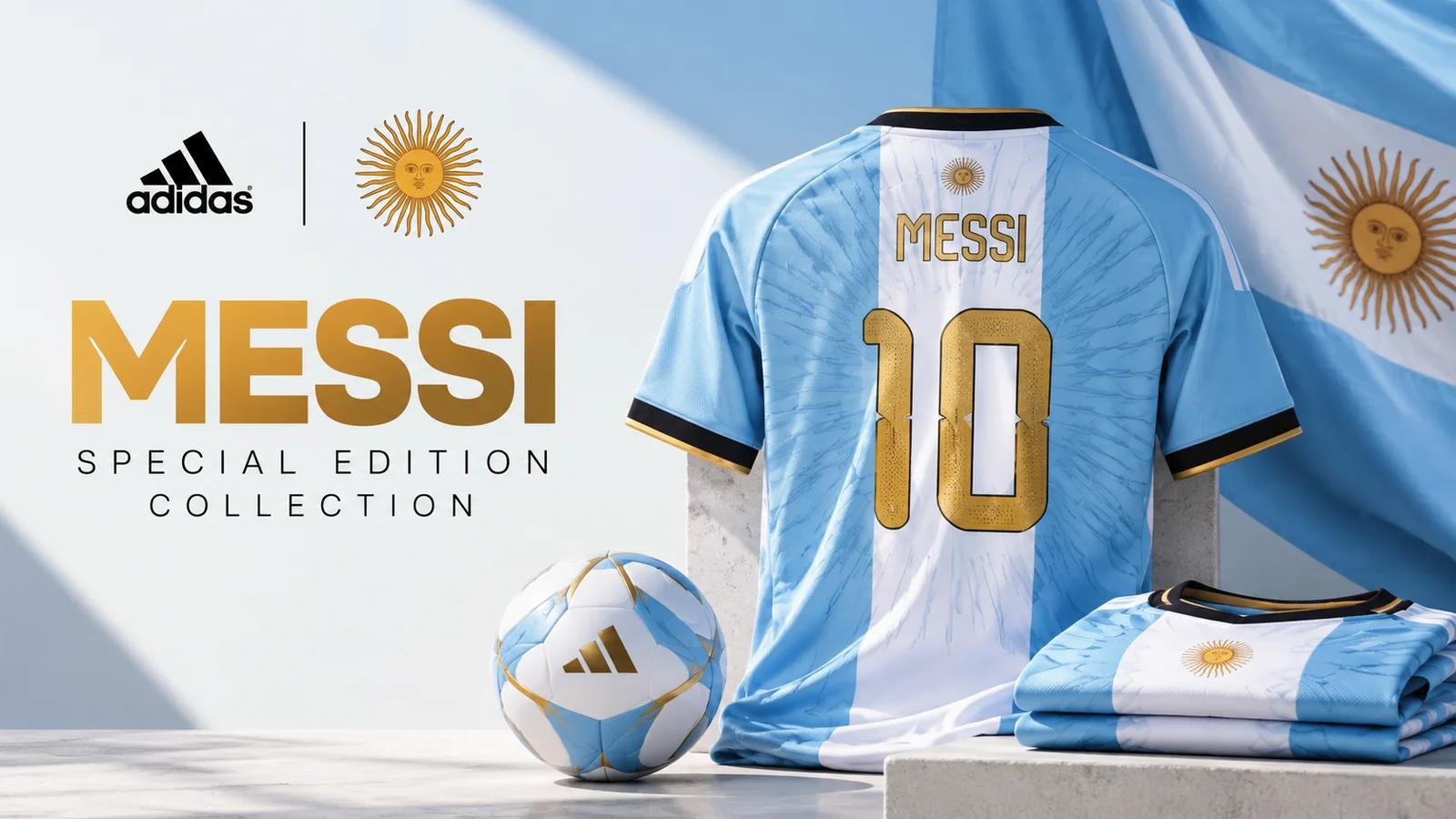
Lionel Messi played his last match for Argentina on 6 October 2026. The shirt he did it in has a single white band instead of the classic stripes, a gold crest, the Sol de Mayo across the whole front and Messi's logo where the adidas logo should be.
Soleback Team
On Monday 6 October 2026, at the Estadio Monumental in Buenos Aires, Lionel Messi played his last match for Argentina. He did it in a shirt that looks like no Argentina shirt before it: instead of the classic sky-blue and white stripes it has a single wide white band down the middle, and the rays of the Sol de Mayo spread across the front and the back. And it contains one detail that adidas has never put on a national team match shirt before.
Argentina beat Benin 3-0 in front of roughly 85,000 people. Messi scored a penalty in the 71st minute and provided two assists: a corner for Nicolás Otamendi's goal in the 48th and a pass for Nico Paz in the 61st.
The right chest of a match shirt always carries the manufacturer's logo. This one does not. In place of the adidas Performance mark sits Messi's own personal logo, in metallic gold.
That is the real story of this shirt. A brand that pays for its three stripes to appear in every match photograph took its own mark off and handed the space to the player.
One caveat belongs here. Trade press describes this as the first case of its kind on an official match shirt, but adidas never officially calls it a first. Goal.com is more careful and talks about a rare distinction. I found no earlier instance, but a precedent you cannot find is not the same thing as a confirmed absence of precedent.
It is also worth knowing that the logo itself was not created for the occasion. Messi has had his own signature line at adidas since February 2013, so the mark has existed for thirteen years. What is new is only the place it occupies.
Before anything else, the practical finding, because it reverses what is happening everywhere else in Europe.
In Poland, Spain and Italy the men's version of this shirt has sold out. The official adidas stores in those countries list the men's replica and the men's Authentic as unavailable. In the United Kingdom both are still on sale. Pro:Direct has the replica in M, L, XL and XXL and the Authentic in M, L and XL, and adidas.co.uk shows both with an add-to-bag button.
What is sold out in Britain is something else entirely, and the distinction matters because the two shirts are constantly confused. The regular 2026 World Cup home shirt with MESSI 10 printing, catalogue number KA8117, is gone in every size at Pro:Direct, out of stock at Very and out of stock at Classic Football Shirts. That is the ordinary tournament shirt with a name on the back, not the farewell design.
So in Britain the scarce item is the common one and the commemorative one is still in stock. If you want the shirt Messi actually retired in, this is a better week for it here than almost anywhere else on the continent.
The official catalogue name is simply Argentina Messi 26 Jersey, and in the brand's own communications the range appears as the Argentina Messi Special Edition Collection.
Construction and colour:
What is gold:
The Sol de Mayo is handled differently from what you would expect. It is not a contrasting sun print but an oversized motif stretched across the front and back, executed as tonal radiating horizontal lines. The pattern is single-coloured and only becomes visible up close or against the light. The Spanish agency Infobae describes the rays more precisely as radiating from the centre of the number 10, which fits the photographs, but that comes from an agency and not from adidas.
The nicest detail is invisible while the shirt is on a player. Under the collar at the back sits a commemorative emblem: the number 10 framed by laurel branches and the Sol de Mayo, with Messi's name.
The kit is completed by black shorts with white adidas stripes and sky-blue and gold trim, plus white socks.
One reported detail I do not confirm. The AP described the gold 10 as having goat horns, a nod to the GOAT acronym. adidas confirms this nowhere and no such element appears in the official materials.
This one is worth a section of its own, because it circulated widely and it is wrong.
There were reports that a British retailer was selling this shirt as a GOAT edition. I searched ten British retailers specifically for it: adidas.co.uk, Pro:Direct, JD Sports, Sports Direct, Lovell Sports, Fanatics, Kitbag, Subside Sports, Classic Football Shirts and Cult Kits. Not one of them sells the Messi 26 jersey under that name.
The word GOAT does appear in British football retail, but on different things. Pro:Direct uses the phrase "national icon and GOAT Lionel Messi" in the body copy of the regular 2026 Argentina home shirts, not the farewell one. Classic Football Shirts sells a 2022-23 Argentina Messi Goat tee. Cult Kits sells a Messi Goat tee at £24.99. Those are cotton t-shirts, not the match shirt.
Treat the GOAT edition as a rumour that did not check out.
Worth noting, because with adidas shirts the reflex is to assume one of those two names. Here it is neither.
adidas does not publish the material composition in percentages for the adult version. For the kids version with the 10, the German and French Unisport stores list 100 per cent polyester, entirely recycled, plus double knit and CLIMACOOL.
These are not rumours. It is a closed matter with specific dates.
From the letter published on 31 August: "It was a decision that hurt and still hurts the soul, but I understand that this is the right moment." And further: "I gave everything, I have nothing more to give, and behind me come great young players who deserve to be here."
After the Benin match he said that wearing this shirt for more than twenty years had been a source of enormous pride, and that he never stopped fighting or giving everything.
One clarification, because it is easy to misread: this is the end of his international career, not the end of his career. Messi is still playing club football.
The numbers after the Benin match:
Trophies with the senior national team:
In addition, outside the senior squad: Olympic gold in 2008 and the Under-20 World Cup in 2005.
Lost finals: World Cups 2014 and 2026, Copa América 2007, 2015 and 2016.
An editorial note, because incorrect versions are circulating. Two large Argentine outlets gave the Copa América titles differently and both got them wrong, one saying 2021 and 2025, the other 2019 and 2024. The correct years are 2021 and 2024, because the tournament runs on that cycle and Argentina finished third in 2019.
At the 2026 World Cup itself Messi scored 8 goals and made 4 assists, took the Silver Boot as the tournament's second top scorer and the Silver Ball as its second best player. He also set a World Cup record with 12 career assists.
Since adidas built an entire shirt on it, it is worth knowing what is depicted.
The Sol de Mayo is a golden sun disc with a human face and rays radiating outwards. The name refers to the May Revolution of 25 May 1810, when the Spanish authorities in Buenos Aires were removed and the independence process began. So it has nothing to do with the season.
The number of rays is not a matter of interpretation but of law. Decree 10302 of 1944 specifies thirty-two rays, alternating flaming and straight, in golden-yellow. That is 16 straight and 16 wavy. For comparison, Uruguay's Sol de Mayo has sixteen rays.
A detail that explains the look of the symbol: the official form of the Sol de Mayo was born not on the flag but on a coin. The 1944 decree refers explicitly to the gold eight-escudo and silver eight-real coins struck under the decision of the Assembly of the Year XIII in 1813 at the Potosí mint, and requires that the same position visible on those coins be preserved.
It is commonly repeated that the sun refers to Inti, the Inca sun deity. This needs careful handling. Encyclopedic sources note that no contemporary documents confirm an Inca origin for the symbol and that the claim emerged later. At the same time, the official Argentine government website itself uses the phrase "Inca sun". An indirect trail runs through the craftsman: the engraver involved in the 1813 seal design, Juan de Dios Rivera Túpac, was described as a descendant of Inca nobility.
The flag itself was designed by General Manuel Belgrano and first raised on 27 February 1812 at Rosario on the Paraná. The Congress of Tucumán confirmed it on 20 July 1816, and the Sol de Mayo was added to the central white band on 25 February 1818 under Juan Martín de Pueyrredón.
What the sky-blue bands mean is a separate dispute. The popular version speaks of sky, clouds and sun. Historians generally reject it and point to colours deriving from loyalty to the House of Bourbon, in a period when the independence forces were formally acting in the name of King Ferdinand VII.
Dropping the stripes is the riskiest design decision on this shirt, because stripes have been Argentina's identifier for over a hundred years.
In the first official international, on 17 May 1901 against Uruguay, Argentina played entirely in white. The sky-blue and white vertical stripes were adopted in August 1908 and the pattern was formally established in 1910, before the Copa Lipton. The AFA crest did not appear on the left chest until 1976.
Abandoning multiple stripes for one wide central band is therefore not decoration but a move from the logic of a shirt to the logic of a flag. Interestingly, one of the most famous shirts in this team's history had a similar arrangement with a pronounced central band, namely the 1986 World Cup shirt, made from breathable Airtex fabric for the Mexican heat. Except that one was made by Le Coq Sportif, not adidas, which several outlets get wrong.
And an anecdote that shows how far this squad has come on kit matters. Before the quarter-final against England on 22 June 1986, Argentina had no lightweight change shirt. AFA office worker Rubén Moschella went round roughly forty shops in Mexico, found two models, Maradona picked one, and two seamstresses hurriedly sewed on the crest and numbers, skipping some of the detailing. The numbers were applied with shiny silver thread that shed glitter onto the players' faces during the warm-up.
The crest on this shirt has three stars and it is gold. Both elements have their own chronology.
Gold in an Argentina shirt is not new either. The gold sun emblem under the collar was already on the 2022 championship shirt. Messi's farewell shirt extends that line rather than opening it.
The wider context is that gold has an established meaning in football and signals a title, an anniversary or champion status. FIFA has run the world champions badge since 2007 in two versions, gold and white, so the reigning champion can match it to the kit. Italy were the first to wear it, on the 2008 shirts. At the 2026 World Cup a further gold badge on the right sleeve for former world champions was introduced, to which Argentina, Brazil, Germany and France are entitled.
A statistical footnote: Argentina are the first team in history to use two different versions of the champions badge at a single World Cup.
Caution is needed here, because sources give three different starting dates for the partnership: 1974, 1989 and 2001, depending on whether you count the first contract or the current unbroken run.
The safest formulation is this: adidas has supplied Argentina intermittently since the 1970s and continuously since 2001. The confirmed interruptions are Le Coq Sportif in the 1980s, including the 1986 World Cup, and Reebok in 1999 and 2000.
The current deal was announced on 25 June 2024 and runs to 2038, that is fourteen years and four World Cups: 2026, 2030, 2034 and 2038. It covers the men's, women's and youth national teams.
The value of the deal was not disclosed. Neither the AFA nor adidas has given a figure. Journalistic estimates circulate of more than twenty million euros a year, against around eleven million to 2020 and fifteen in the extension to 2026, but those are estimates and not confirmed numbers.
Prices in pounds, read on 7 October 2026.
The farewell edition:
Pro:Direct matches adidas on price and beats it on information, because it publishes stock per size:
That per-size detail is the single most useful thing in this article if you wear an XS or a triple XL, because at both of those ends the farewell shirt has already gone and no amount of refreshing the page will change it.
One contradiction to flag: the adidas.co.uk collection page marks LD3319 as sold out while the product page for the same number shows £85 and an add-to-bag button. Both read the same day. Trust the product page, not the grid.
The regular 2026 kit, where the discounting is considerably more aggressive:
So the same plain home shirt ranges from £60 to £90 depending on where you look, and the Authentic from £70 to £130. On the Authentic that is a sixty pound gap on an identical garment.
Browse the Messi 26 jersey at Pro:Direct and the Authentic version there, the Argentina Messi shirt at Sports Direct, the Argentina section at JD Sports and the Messi range at Fanatics.
A warning about currency on some of these sites. Fanatics and Kitbag both served me US dollar prices on their British domains until I forced the storefront to pounds, and Subside Sports and Classic Football Shirts default to a dollar storefront. If the price you see has a dollar sign in front of it, you are not on the British store and that number is not what you will be charged. Check before you reach the basket.
Separately worth knowing: name and number printing is not separately priced at any British retailer I checked. adidas.co.uk offers personalisation without displaying a surcharge. The only itemised add-on is the FIFA WC26 Gold Player badge.
This is the most practical section in the article if you plan to hunt this shirt over the coming weeks or buy it secondhand.
I checked the adidas stores in six countries and the result is unambiguous: the farewell version is the LD33xx series and nothing else. The British, German, Polish, French, Spanish and Italian adidas stores all use the same numbers: LD3319 men's replica, LD3315 men's Authentic, LD3318 women's, LD3310 kids, LD3307 kids with the 10, and KW2024 Authentic in Aurora Ivy.
Two more numbers turned up at retailers and appear in no guide:
And now the trap. The numbers KH3943, KH3940, KH3934, KA8117 and KA8115 are not the farewell edition. They are the ordinary 2026 World Cup kit with MESSI 10 printing, circulating as the farewell shirt only because the name contains "Messi 26". Specifically:
The practical difference: KA8117 is a shirt with a printed name on a standard tournament base, with no gold crest, no Sol de Mayo and the usual adidas logo on the chest. When buying secondhand, check the right chest, not the listing title.
An honest addition about the product copy. Not one English-language product description I read mentions gold, the Sol de Mayo or the Messi logo. adidas.co.uk's text for LD3319 refers only to "the club crest and iconic 3-Stripes". The descriptions are generic tribute wording plus CLIMACOOL boilerplate.
If you want a retailer description that actually describes the object, you have to look at the Spanish listings. Fútbol Emotion names the Sol de Mayo as the lead design element, the gold details, Messi's personal logo and the commemorative number 10 detail with laurel branches. That is the only retailer description across six countries that tells you what you are buying.
Yes, but with an important distinction that shows why the Argentine one is different.
The closest confirmed precedent is Juventus and Alessandro Del Piero, the ADP10 collection launched on 16 December 2025. That had the number ten, the player's signature, the dates of his debut and last club match, and artwork referring to the nickname given to him by Gianni Agnelli. But it was a pre-match shirt rather than a match shirt, and the adidas logo stayed where it was.
From other brands: AS Roma produced a farewell collection for Francesco Totti, Barcelona the "Infinit8 Iniesta" shirt in 2018, and Parma an anniversary goalkeeper shirt for Gianluigi Buffon in November 2021, which in fact marked the twenty-sixth anniversary of his debut rather than a farewell. None of those was made by adidas and none involved a national team.
An interesting counterpoint from the same season: adidas also prepared a farewell shirt for Germany, closing a partnership with the German federation that began in 1954, that is seventy-two years. A black base with gold vertical diamonds. From 2027 Germany will be supplied by Nike. So in one season adidas said goodbye to a player and to a federation, and both shirts use gold as the motif.
Three things will decide how this shirt looks in a few years.
First, the production run has not been stated. adidas describes the product as a special edition but publishes no numbers. Retailers add the words LIMITED EDITION on their own account. Media use the word limited, also without numbers. That matters, because with anniversary shirts a run is often stated outright. Juventus, for their 120th anniversary shirt in 2017, gave 1897 units, the year of the club's founding. Here there is no such figure.
Second, it is the first national team match shirt carrying the player's logo instead of the manufacturer's, at least as far as can be established. If the precedent is not repeated, that will remain its defining feature.
Third, Britain currently has what other markets do not. While Poland, Spain and Italy have written the men's version off, it is on sale here in two shops with real size availability. That window will not stay open indefinitely.
Collected in one place so it is clear where the facts stop:
The retailers named in this article, Pro:Direct, Sports Direct, JD Sports and Fanatics, are Soleback partner shops. On an £85 shirt or a £130 Authentic, a percentage rebate is a real sum rather than a rounding.
Worth noting: adidas.co.uk is not a partner shop, so buying direct from the manufacturer generates no rebate. Since Pro:Direct carries the same farewell shirt at the same £85 and publishes per-size stock on top, this is one of the rare cases where the partner route is also the better-informed route.
Browse the Messi 26 jersey at Pro:Direct, the Argentina range at Sports Direct, the Argentina section at JD Sports and the Messi collection at Fanatics.
In practice the easiest way to run this is with the browser extension, which reminds you of the active rate as soon as you land on a shop page. New accounts can use the welcome bonus, and the help centre explains what to do if a transaction does not register. It is also worth checking the current promotions before you buy.
The shirt went on sale on 25 September 2026 and made its pitch debut on 6 October, in Messi's final match for Argentina.
Its most important element is not the gold or the Sol de Mayo but the disappearance of the adidas logo from the right chest and its replacement by the player's own mark.
Abandoning the classic stripes for one wide central band is a move from the logic of a shirt to the logic of a flag, and the Sol de Mayo is treated subtly, as tonal lines rather than a contrasting print.
In Britain the men's version is still available at £85, with Pro:Direct publishing which sizes survive, while Poland, Spain and Italy have sold out.
If you take the plain home shirt instead of the farewell edition, compare a few shops, because the £60 to £90 spread on the replica and the £70 to £130 spread on the Authentic are both larger than most sale events.
Save on your next purchase
Browse our partner stores for cashback deals and voucher codes
Soleback Team
Author